When you click on links to various merchants on this site and make a purchase, this can result in this site earning a commission. Affiliate programs and affiliations include, but are not limited to, the eBay Partner Network.
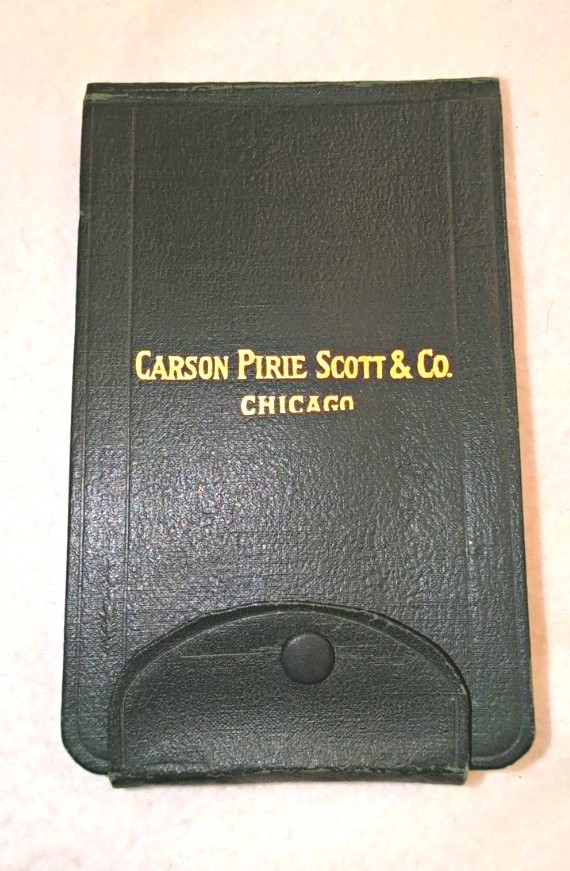
Antique / Early 20th Century Carson Pirie Scott & Co. Pocket Department Directory & Ledger Notepad.Historical Context:While most people today associate Carson, Pirie, Scott & Co. with retail shopping along State Street—most notably at the famous LouisSullivan-designed building, the Sullivan Center—the company’s primary engine of growth throughout the late 19th century was its wholesale dry goods trade.
During this era, Chicago was the undisputed distribution gateway connecting Eastern textile mills with general stores, dry goods shops, and dry goods peddlers spreading across the Midwest, the Plains, and the Western frontier.Dry goods giants like Carson Pirie Scott & Co., Marshall Field & Co., and John V. Farwell & Co. competed fiercely for regional merchant buyers who traveled into Chicago multiple times a year by train to stock their stores for upcoming retail seasons.2. The Adams, Franklin & Market Wholesale District
The address printed on the first page—Adams, Franklin and Market Streets—places this item directly in Chicago’s historic wholesale district along the Chicago River (the area now largely occupied by West Loop high-rises and transit corridors).Following the Great Chicago Fire of 1871, dry-goods wholesalers clustered west of State Street toward the river to access rail spurs, river freight, and warehouse space.By 1890, Carson Pirie Scott expanded significantly at the northwest corner of Adams and Franklin, eventually acquiring leases spanning the entire block frontage to Market Street to house their six-story wholesale showrooms and warehouses.3. "The Great Central Market" Campaign
The tagline printed above the directory, "The Great Central Market," reflects an organized civic and commercial promotional movement that arose in Chicago during the 1890s and peaked around the 1900s. Chicago merchants united under this banner to convince national and Midwestern retailers that all necessary goods—from staple textiles and furs to jewelry, fixtures, and notions—could be sourced directly in Chicago without traveling to New York or Boston.4. Function of the Pocket Memo Directory
This book was not a public giveaway for retail shoppers; it was a functional tool for wholesale floor buyers and commercial traveling sales agents:
Stepped Room Tabs: Wholesale warehouses occupied hundreds of thousands of square feet divided into specific showrooms ("1st Floor North Room," "2nd Floor Main Room," "6th Floor West Room"). The stepped tabs let visiting merchants quickly flip to the exact room number and department manager.Salesman Tracking: Each printed section includes a blank line for "Salesman" so visiting buyers could record the specific house salesman or traveling drummer representing that department line (e.g., Ginghams, Linens, Cloakings).Personal Inscription: The purple hand-stamp at the top—"Fred E. Clark"—indicates it was the personalized tool of an individual buyer, commercial clerk, or traveling agent assigned to Carson Pirie Scott’s wholesale division.Company/Location: Carson Pirie Scott & Co., Wholesale / Great Central Market, Adams, Franklin, and Market Streets, Chicago.Format: Flip-top vertical pocket memorandum book featuring an integrated printed floor-by-floor department index with stepped tab dividers, interleaved with red-and-blue grid ledger/graph note sheets.Cover Material: Dark olive/black grained leatherette (or textured thin leather) with blind-stamped border lines and bright gilt-stamped lettering on the front: "CARSON PIRIE SCOTT & CO. CHICAGO".Closure: Folding flap with a metal snap fastener button.
Interior Details:Top inside lid has a pale lining hand-stamped in purple ink: "Fred E. Clark".Opening department summary directory listing floors 1 through 6, citing specific wholesale departments (e.g., Domestics, Ginghams, Woolens, Shawls, Ribbons, Notions, Drug Sundries, etc.).Stepped cardstock index tabs along the bottom corresponding to floors and showrooms (e.g., 1st Floor North Room, 2nd Floor Main Room, 3rd Floor, 4th Floor, 5th Floor, 6th Floor).Specific department pages listing product categories, department codes, and blank "Salesman" lines.This pocket directory was produced circa 1895 to 1905 (late 1890s to early 1900s).The dating is pinned down by specific historical details printed inside:Wholesale Warehouse Location: The directory lists the address as Adams, Franklin and Market Streets. Carson Pirie Scot