When you click on links to various merchants on this site and make a purchase, this can result in this site earning a commission. Affiliate programs and affiliations include, but are not limited to, the eBay Partner Network.
Size: 9.5 x 5 inches
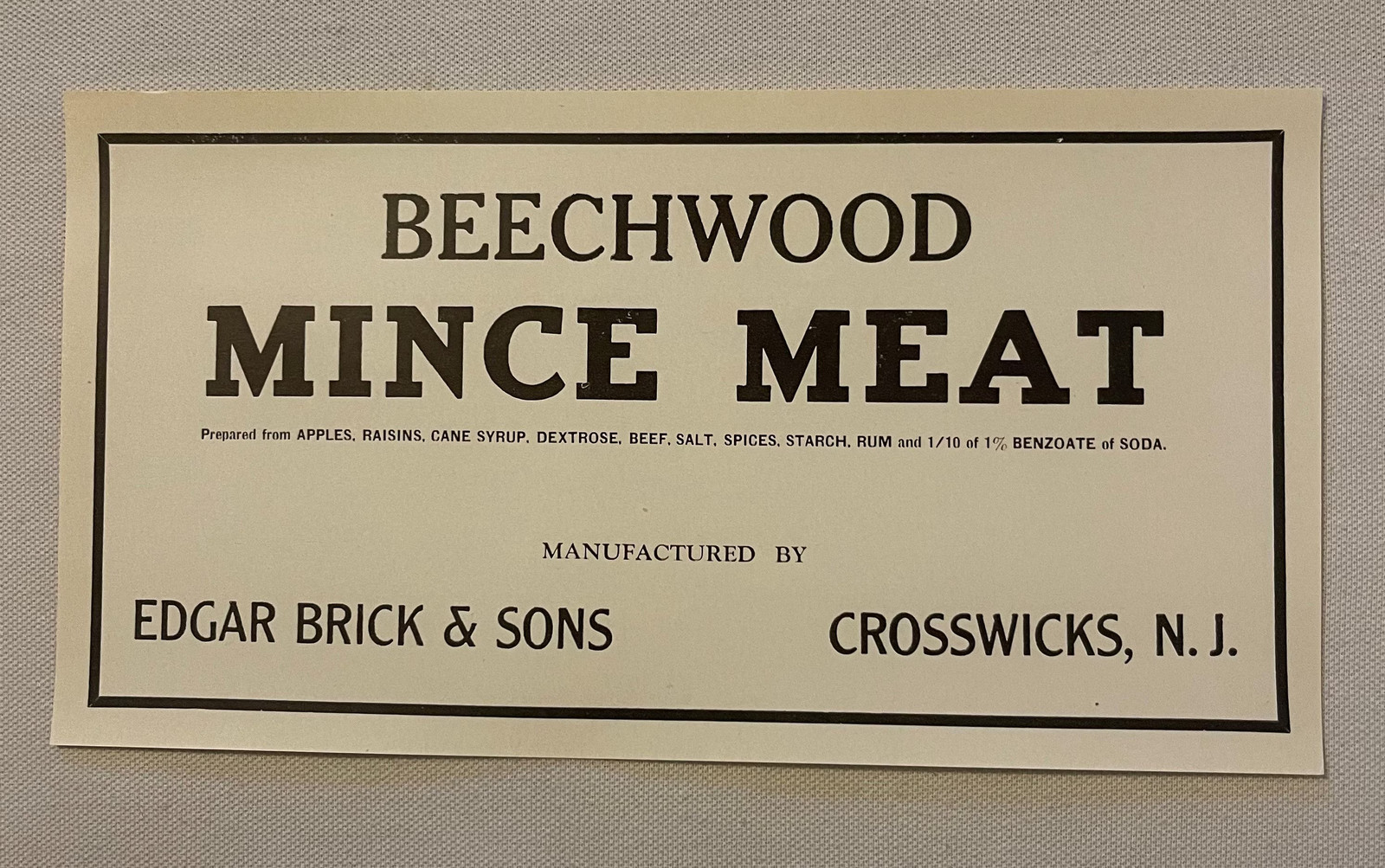
🥧 Beechwood Mince Meat Label — Crosswicks, New Jersey
Unused paper label from the Crosswicks company that grew into the largest mincemeat manufacturer in the United States. Black on cream, with the whole recipe printed on its face, rum and a preservative declaration included.
📋 SPECIFICATIONS
- Brand: Beechwood Mince Meat
- Maker, as printed: Edgar Brick & Sons, Crosswicks, N.J.
- Ingredients, as printed: apples, raisins, cane syrup, dextrose, beef, salt, spices, starch, rum and 1/10 of 1% benzoate of soda
- Printing: black ink on cream paper, heavy black border
- Back: blank; the front printing shows faintly through
- Type: food label, large version
🗃️ CONDITION
New old stock, never applied to a container. Crisp print on cream paper, as shown.
📜 THE STORY
76 pounds to three million. Edgar Brick ran a general store on Main Street in Crosswicks with his wife Susan, disliked the Philadelphia mincemeat he stocked, and made his own in 1874 — 76 pounds the first year. In 1879 two farmhouses were moved and joined to make a factory. His sons Arthur, Josiah and Charles took over after his death in 1920, and during World War II the plant\'s 40 workers made three million pounds a year, the most of any mincemeat maker in the country. Mincemeat production ended in 1968 and the company closed in 1979.
Rum and the law. After national Prohibition began in 1920, an October 1922 federal court case won by a Chicago distillery kept alcohol legal in cooking, mince pie included. Brick\'s Prohibition-period Banquet Hall label printed \"FEDERAL PROHIBITION PERMIT N.J. H-926.\" This Beechwood label names rum with no permit line.
The benzoate line. Benzoate of soda was at the center of Harvey Wiley\'s Poison Squad fight over preservatives; after a scientific board led by Ira Remsen disagreed with Wiley, a 1909 federal decision allowed it at up to one-tenth of one percent when declared on the label.
The village and the building. Crosswicks was settled by Quakers around 1677, and on June 23, 1778, American militia fought British troops at its creek bridge, five days before Monmouth. The Brick factory still stands there; Preservation New Jersey listed it as endangered in 2017, with sections of its roof collapsed.
🎁 GOOD FOR
- Farmhouse kitchen and Thanksgiving display framing
- New Jersey and Burlington County history collectors
- Food label, grocery and Prohibition-history collectors
- Gifts for bakers and mince pie lovers