When you click on links to various merchants on this site and make a purchase, this can result in this site earning a commission. Affiliate programs and affiliations include, but are not limited to, the eBay Partner Network.
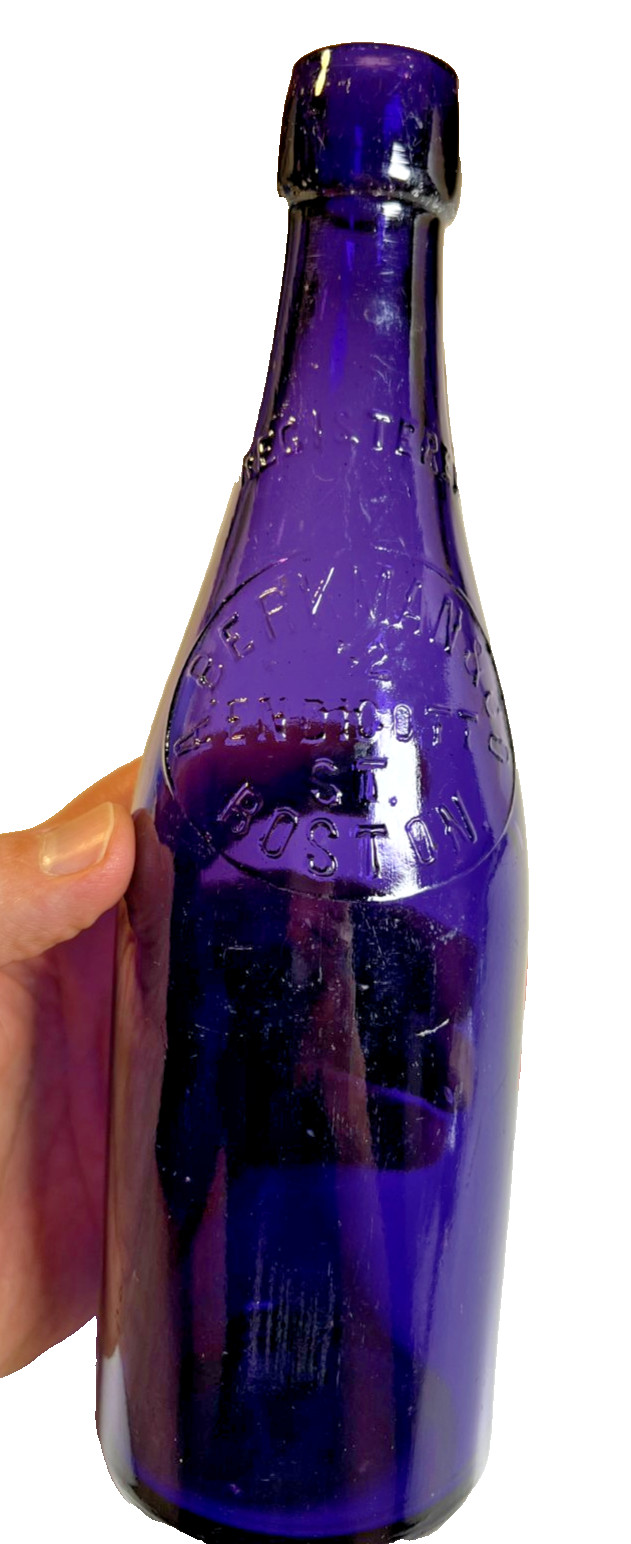
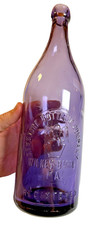
This striking bottle is a late-19th-century Boston beer / liquor bottle, hand-blown in extraordinarily thick glass, finished with an applied blob top, and boldly embossed:
A. PERKMAN
ENDICOTT ST
BOSTON
Its most captivating feature is its deep, saturated amethyst color—a rich purple hue that only forms after decades of sunlight interacting with manganese-rich glass. This is not a modern tint or stain; it’s a chemical transformation born of time, making each example unique. When light passes through it, the bottle glows with a jewel-like intensity that collectors chase hard.
How It Was Manufactured
This bottle was mouth-blown, not machine-made.
Here’s what that means in practical, tactile terms:
Molten glass was gathered on a blowpipe and shaped by hand
The body was expanded using breath and gravity, not automation
A separate blob of molten glass was applied to form the lip
The embossing was created inside a multi-part mold, pressed deeply while the glass was still hot
That’s why:
The glass is unusually thick
The embossing is bold, raised, and crisp
The bottle has a slight organic asymmetry you can feel in hand
This is labor-intensive glassmaking from the pre-assembly-line era, when durability mattered more than speed and bottles were expected to survive reuse, transport, and rough handling.
That Purple Color (Why It’s So Beautiful)
Originally, this bottle would have been clear or light aqua.
The purple color developed slowly as:
Manganese dioxide (used as a glass clarifier)
Reacted to ultraviolet light
Over many decades, often sitting in windows, dumps, or exposed storage
The result is this deep amethyst tone, sometimes called sun-colored amethyst (SCA). Bottles with even, rich coloration like this are especially prized, and thick Boston bottles tend to purple beautifully due to their density.
In short:
You can’t fake this color. Time had to do the work.
Endicott Street, Boston – A Bottling Powerhouse
During the 1870s–1890s, Endicott Street sat in the heart of Boston’s North End industrial and commercial district.
Yes—there were many bottlers and liquor dealers on Endicott Street, including:
Why there?
Close to the waterfront and rail depots
Dense immigrant labor force (especially German and Irish brewers)
Easy access to taverns, grocers, and shipping routes
A. Perkman wasn’t operating in isolation—this bottle comes from a crowded, competitive bottling ecosystem, which makes embossed, address-specific bottles like this one important identifiers of now-vanished businesses.
Many Endicott Street firms disappeared by the early 1900s, wiped out by:
Life in Boston When This Bottle Was UsedDaily Life
Boston in the 1880s–1890s was:
Loud, crowded, and industrial
Dominated by horse traffic, steam power, and coal smoke
Filled with corner saloons, beer halls, and working-class taverns
Beer was safer than water. Bottled alcohol wasn’t a luxury—it was part of daily life.
Politics
Strong labor movements were forming
Tension between temperance advocates and working-class drinkers was rising
Boston politics were famously rough-and-tumble
Immigrant communities wielded growing political power
This bottle quietly predates the moral storm that would eventually shut places like Perkman’s down.
Technology
Electricity was just beginning to appear
Gas lamps still ruled the streets
Telegraphs and railroads connected Boston nationally
Bottles like this were reused again and again—returnable long before “recycling” was a word
Medicine
Germ theory was still gaining acceptance
Alcohol was commonly prescribed for digestion, nerves, and “vitality”
Pharmacies and liquor dealers often overlapped
Beer and spirits were considered safer than untreated water
This bottle likely passed through both taverns and households, handled daily, not displayed.
Why This Bottle Matters Today
This is more than glass—it’s:
A survivor of Boston’s pre-Prohibition drinking culture
A tangible artifact of hand labor and local commerce
A visually stunning example of sun-colored amethyst glass
A bottle tied to a specific street and vanished business
It has presence. It looks heavy because it is heavy. And that purple glow is the kind collectors stop scrolling for.
Measurements & Condition
Height: approx. 9" (top off)
Base diameter: approx. 2¾"
Condition: Very good overall; no structural damage noted. No chips, no cracks, no ghosting. Bright/clean and shiny. Just some very faint hairline scratches (no notable case wear marks)
Glass: Exceptionally thick, bold embossing throughout