When you click on links to various merchants on this site and make a purchase, this can result in this site earning a commission. Affiliate programs and affiliations include, but are not limited to, the eBay Partner Network.
🌅 What Flew From the Masts of Spain's Golden Age? ⚓
Size: 16" x 12" ~ new old stock, never framed or hung, the ink still bright.
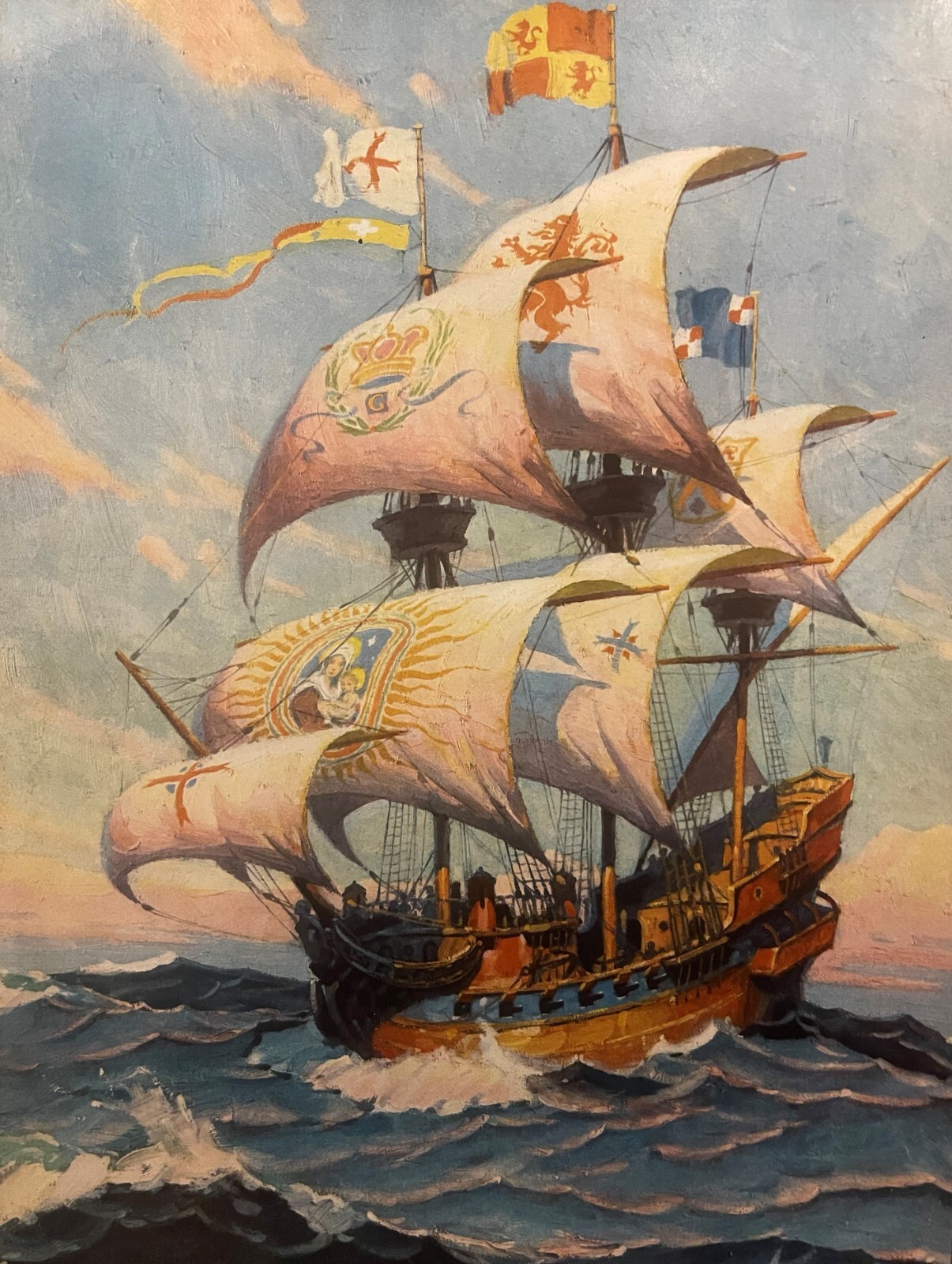
Matinee swashbucklers, boyhood atlases, harbor taverns with a ship's wheel nailed to the wall, a grandfather's study lined in brass and old books - a galleon under full sail is the daydream all of that was made of. This one even comes with a name and a painter. It's an antique print of "La Buena Ventura, Spanish Treasure Frigate," painted by the California marine artist Joe Duncan Gleason.
📋 SPECIFICATIONS
- What it is: an antique art print, unframed - a reproduction of Gleason's painting, not the original canvas
- The painting: "La Buena Ventura, Spanish Treasure Frigate," by Joe Duncan Gleason (1881-1959)
- This printing: 16" x 12", trimmed right to the picture with no margin, blank back, no caption and no signature line
- The other edition: the same picture was also published with a margin caption, "Duncan Gleason" signed in the plate and a "(c) L.A. Pub. Co." imprint; these sheets are a separate, larger printing, cropped a touch tighter along the bottom
- On the sails: a rampant lion, a crowned wreath around a letter G, and the Madonna and Child in a sunburst
- Era: antique, 1930s
🔎 CONDITION
New old stock, meaning never used. These are printer's sheets that sat in supply, never framed and never hung, which is why the ink is still bright. It comes unframed, so the frame is your call, and 16 x 12 is a standard frame size.
🎨 THE MAN WHO PAINTED HER
Gleason was born in Watsonville, California, in 1881, and grew up in Los Angeles - the family moved to Boyle Heights when he was a baby. His mother used to walk him down to San Pedro harbor to look at the wreckage of boats washed up on the beach, and by the time he was seven he was filling a black ledger book with drawings of them.
The sea was already in the family. His grandfather, James Henry Gleason, was supercargo for Paty & Co., the man in charge of the trading bark Don Quixote's cargo, at Monterey in 1846. And his great-grandmother was a Californio woman named Mariana Buena Ventura Escamilla. Every time I read the name on this ship, I think of her.
He came up the working way, through engraving. At fourteen he was already earning a wage at the Union Engraving Company. He studied under Lees Judson at the University of Southern California, went north to the Mark Hopkins Institute of Art in San Francisco while the Sunset Engraving Company paid his bills, then on to the Art Institute of Chicago and Frank DuMond's classes at the Art Students League in New York. Coast to coast, and all of it before he was much past twenty. From 1903 to 1914 his illustrations ran in Ladies' Home Journal, Cosmopolitan and Leslie's Monthly, and in 1922 he wrote and illustrated "Windjammers," a book of etchings.
🎬 FROM A SAN PEDRO HILLSIDE TO CAPTAIN BLOOD
In 1924 the Gleasons rented a studio up on a San Pedro hillside, looking straight down on the Los Angeles harbor, and he became president of the brand-new Artists Club of San Pedro. That's when ships took over his work for good.
Hollywood found him, too. He worked in the art departments at MGM and Warner Bros., making sure the ships on screen were right and drawing them for the studios. Through the Depression, pirate movies and high-seas adventure were about as popular as pictures got, and a set artist who really knew rigging was in demand. His first Warner Bros. film was Captain Blood in 1935, with Errol Flynn, and the two of them worked together again on The Charge of the Light Brigade and The Adventures of Robin Hood. They ended up friends over the thing they both loved most, the sea.
He painted for the steamship companies as well - postcards for the Dollar Steamship Lines and American President Lines - and his later books were "The Islands and Ports of California" (1958) and "Sketches and Paintings from Mexico" (1963). He was in the art competition at the 1932 Los Angeles Olympics, his work is in the Laguna Art Museum today, and he died in Glendale in 1959 and rests at Forest Lawn.
🖼️ A PAINTING POPULAR ENOUGH TO PRINT TWICE
L.A. Pub. Co. put Gleason's ships out as a series, each with its caption in the margin - his USS Constitution, "Old Ironsides," carries the same publisher's imprint - so this galleon had company. What I have here is the other printing: the galleon on her own, bigger than the captioned sheet, trimmed off with no margin and no name on it. Publishers don't print a picture a second time unless people kept asking for it.
⚜️ WHAT THE SAILS ARE SAYING
Look up at the canvas: a rampant lion, a crown over a wreath with a G inside it, and the Madonna and Child glowing in a sunburst. I like to think that G is Gleason tucking his own initial into his own ship.
The rest of it isn't decoration for its own sake. Crowned letters flew for real: in October 1492 Columbus's captains carried a banner with a green cross and an F and a Y, each under its own crown, for Fernando and Ysabel, and he flew it on every ship he had. The Madonna was serious business too. When the treasure galleon Nuestra Señora de la Concepción went down on the Silver Bank in 1641 with at least a hundred tons of silver aboard, she had a statue of the Virgin, her patroness, bolted to the poop deck where every man aboard could see it. And in 1626 a statue of Our Lady sailed out of Acapulco across the Pacific on the galleon El Almirante; the safe passage was put down to her, she took the name Our Lady of Peace and Good Voyage, and she made six more galleon crossings as their patroness.
Buena ventura is Spanish for good fortune. Paint that name on a ship dressed like this and every sail is asking for the same thing.
⚓ THE SHIP HERSELF
Gleason knew his rigging. Three towering masts carrying a full press of canvas, fighting tops mounted high for lookouts and marksmen, a built-up sterncastle trimmed in gold, and a run of gun ports down the hull - cannon ports, not oar ports, because a ship like this was sailed, never rowed. That's the look of the great Spanish treasure fleets, the galleons that hauled silver home from the Americas and carried silk and spice across the Pacific from Manila, built heavy and high because the water they crossed was never safe. The waves breaking at her bow put you right down at sea level with her, and that's why she looks like she's moving.
Bring home a little Spanish sunset and a ship that's still under full sail after all these years. 🌊