When you click on links to various merchants on this site and make a purchase, this can result in this site earning a commission. Affiliate programs and affiliations include, but are not limited to, the eBay Partner Network.
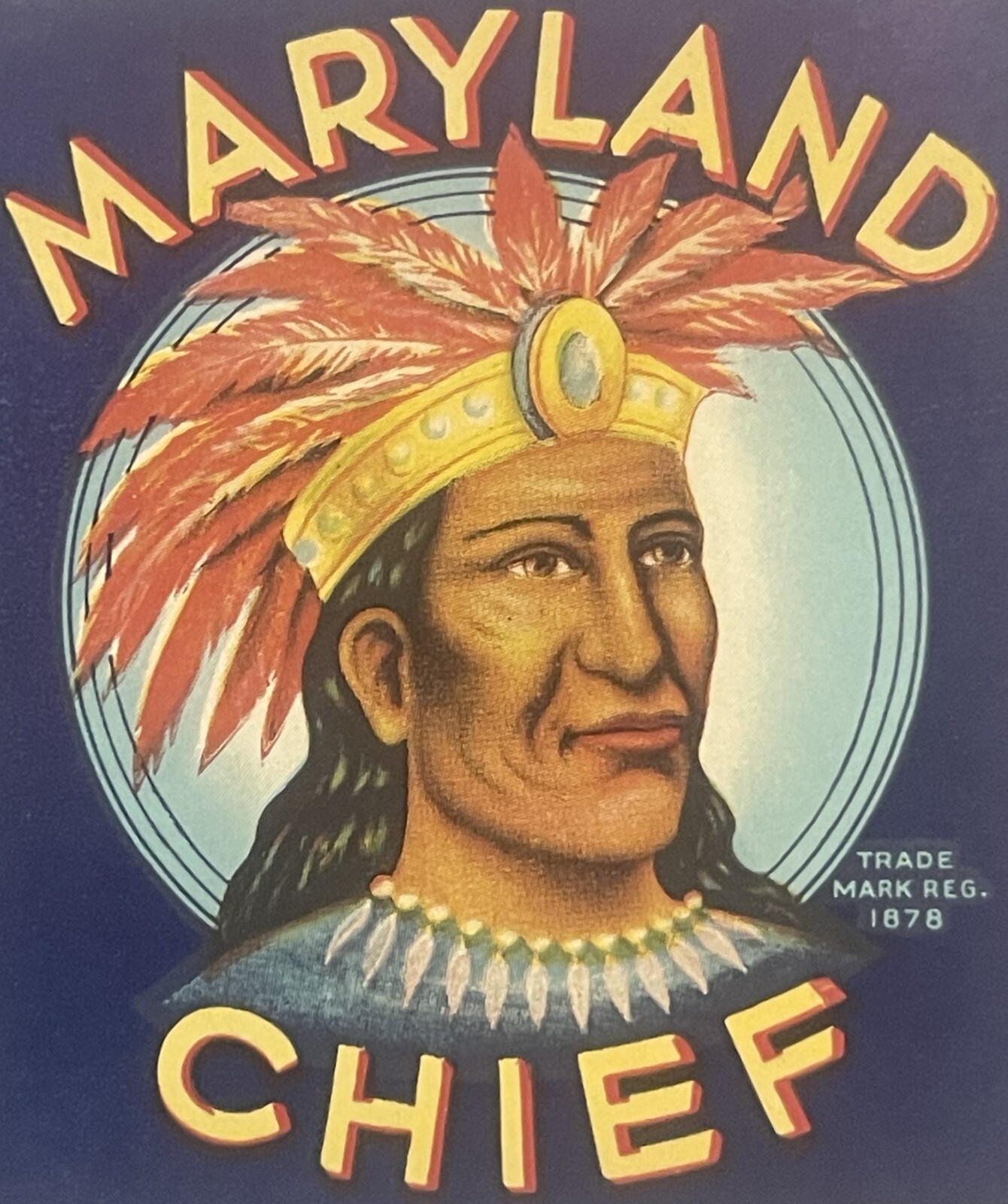
🥫 This label dates itself. Beside the chief's shoulder it prints TRADE MARK REG. 1878; in the directions panel it prints QUALITY CANNERS FOR OVER 60 YEARS. Put the two together and the sheet came off the press in the late 1930s — an original unused Maryland Chief Brand Extra Sifted Early Peas can label from J. Langrall & Bro. Inc., Baltimore, original paper can label, unused cannery stock
Brand: Maryland Chief Brand, Extra Sifted Early Peas
Packer: J. Langrall & Bro. Inc., Baltimore, Md.
Size: approx. 11" x 4 1/2" ~
Printed panel: Size of Can No. 2 · Sieve No. 2 · Net Contents 1 lb. 4 oz. · Cups Approx. 2 1/2 · Servings 4 to 5 · READY TO SERVE, HEAT ONLY · PRODUCT OF U.S.A.
Printer's imprint: Simpson & Doeller, Balto., Md.
Era: late 1930s, from the label's own “over 60 years” line against its 1878 trademark
CONDITION
New old stock. Never pasted to a can, stored flat, colours full and unfaded. Not a modern reprint.
THE STORY
The wrap carries the chief in his red feathered headdress at both ends and a serving panel between them, with the packer's promise that the peas were “carefully packed from fresh young tender peas only a few hours from the field” and a recipe that ends “be sure the Peas never boil”. The recipe's word “liquor” is the canner's term for the packing liquid in the tin, nothing stronger.Extra Sifted and Sieve No. 2 are a spec, not a slogan: canned peas are graded by the size of the circular opening they pass through without force — sieve 1 the tiniest, sieve 6 the largest and mealiest — and “sifted” means the sizes have been separated out. Early, or Early June, is the smooth-skinned Alaska-type pea, first of the season.J. Langrall & Bro. was one of the vegetable packing houses along the Boston Street corridor in Southeast Baltimore, close to the boats bringing produce up from the DelMarVa peninsula and to the rowhouses of the immigrant and African-American families who worked the lines. The firm was running the Maryland Chief mark on oysters as early as 1913. Baltimore was the capital of American canning: Thomas Kensett moved his patented tin-can oyster packing there in 1849, the city held more than a hundred packing houses by 1870, and A. K. Shriver invented the steam retort there in 1874 — the pressure cooker that made mass canning possible.The imprint in the corner, Simpson & Doeller, was one of Baltimore's great can-label lithographers; The Henry Ford holds one of their tomato labels from the 1910s. Most Maryland Chief labels were glued to tins and destroyed. Unused sheets survive only because bundles were left in a storeroom when a design or a pack size changed.
GOOD FOR
Framing for a kitchen, pantry or dining room; Baltimore and Maryland history collections; food packaging, advertising art and lithography collections.