When you click on links to various merchants on this site and make a purchase, this can result in this site earning a commission. Affiliate programs and affiliations include, but are not limited to, the eBay Partner Network.
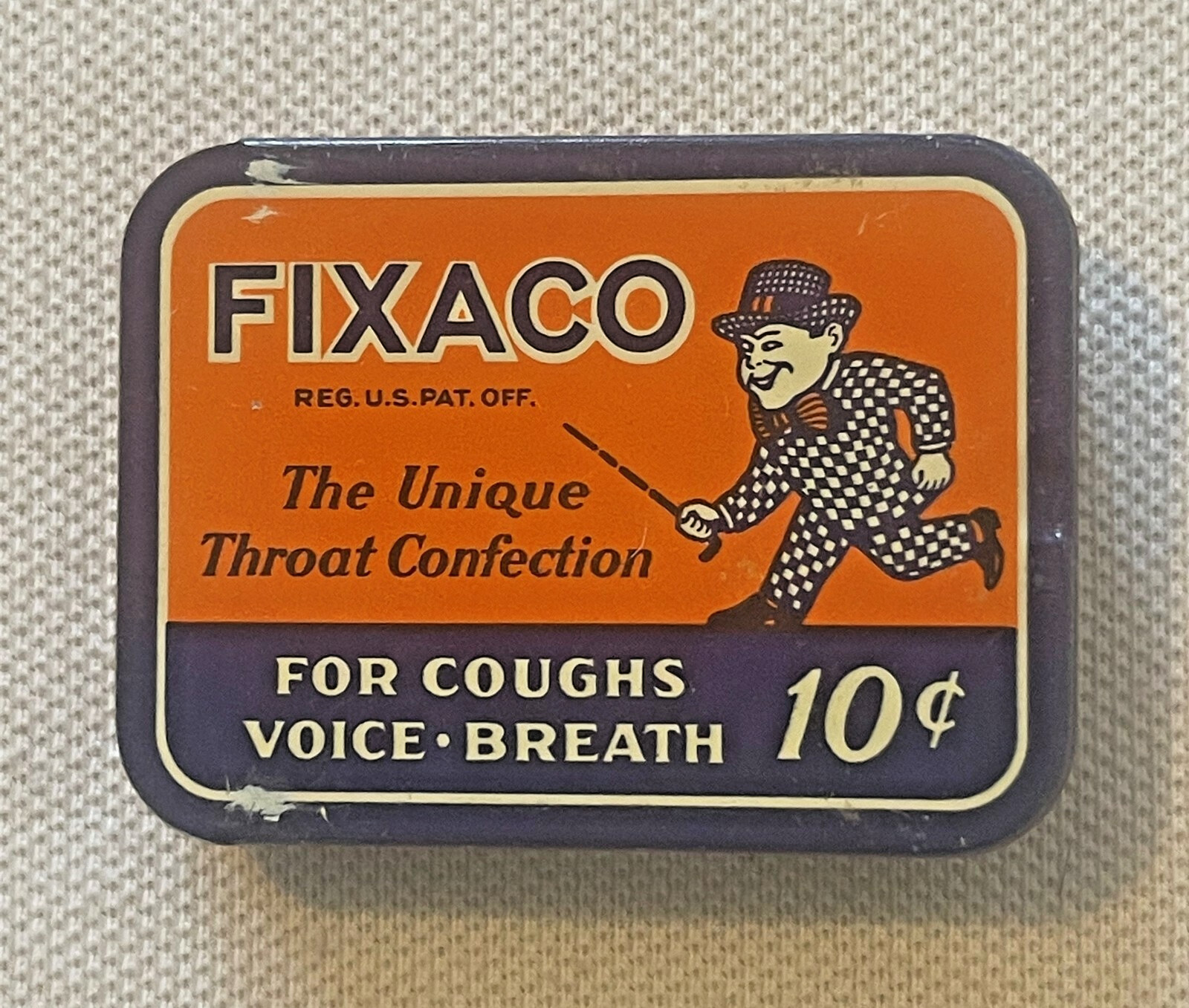
FIXACO "The Unique Throat Confection" Pocket Tin, St. Louis
Size: 2 x 1.25 inches ~ Some light age wear, colors still bright.
The Dandy on the Lid
Long before antibiotics sat in every medicine cabinet, a dime bought you something for a sore throat, and this little drugstore tin held FIXACO, "The Unique Throat Confection," a 10-cent lozenge from The Fixaco Co. of St. Louis. Bright orange over a navy band, small enough to disappear into a coat pocket, with a grinning dandy in a checked suit, a little banded hat and a bow tie, swinging his cane across the face. Some dealers nickname him the Monopoly Man, and it's easy to see why - but there's no documented tie between the two. Parker Brothers' mascot, designed by Daniel Fox, didn't appear until 1936, a dozen years after the Fixaco mark was filed, and he wears a proper top hat, where the Fixaco dandy sports a short-brimmed one with a band. The resemblance is a coincidence of the era's taste in dapper pitchmen, not a connection. His suit checks run tight squares on some tins and a dotted weave on others, just how the printing plates fell. Inside, the tin is a plain gold lacquer, empty; FIXACO is also faintly stamped along the outer wall of the tray, pressed so shallow it's hard to say whether it was printed or embossed.
The back gives the company's own pitch, printed in full: "FIXACO is something different. It is highly concentrated and effective. Don't chew Fixaco. Hold in roof of mouth until dissolved. Use freely. For Coughs, Colds, Sore Throat, Hoarseness. Excellent for Children's coughs." It's aimed at a particular crowd too - "For Singers, Speakers, Teachers, Etc." - anyone who made a living with their voice - and it adds that after smoking, Fixaco "moistens mouth and throat, also sweetens the breath." The company signed off with a line that reads very differently now: "Fixaco contains no harmful ingredients." Dealers who've dug into the formula over the years report its active ingredients as licorice, menthol, anise and glycerine - nothing on the tin itself confirms it, but it lines up with a rival throat-lozenge tray of the era that lists licorice among its own main ingredients.
A St. Louis Trademark
The Fixaco name, filed for The Fixaco Company of St. Louis and San Francisco, went to the U.S. trademark office on July 2, 1924, claiming use back to May 20 of that year, and was registered in the U.S. on February 10, 1925 and in Canada that September 22 - the "REG. U.S. PAT. OFF." stamped on this lid means it came after the U.S. date. That spelled-out notice, rather than a small (R), is the older form: the circle-R trademark symbol didn't exist in U.S. law until the Lanham Act of 1946. The company was chartered in St. Louis in 1925 with $75,000 in capital, bought an ad in the 1931 program of the Muny, the city's outdoor opera, rode St. Louis streetcars on advertising signs, and was still selling its lozenges through the Anfenger agency in 1945 - years that also brought the 1937 Elixir Sulfanilamide disaster, 105 dead from a mislabeled medicine the FDA could barely touch, and the 1938 Food, Drug, and Cosmetic Act that followed it, requiring real proof of safety and honest directions from any company selling a remedy like this one.
The story goes that a batch of these turned up decades later as unused old stock in a St. Louis factory building.
What Became of the Name
Here is where it gets strange, and I will say up front that none of it touches the little tin in these photos. The FIXACO mark was filed in 1924 and passed through more than one set of hands, and nobody has established when the last owner picked it up. But the name turns up again in 1967, and not in a drugstore.
That year federal agents found roughly 625,000 amphetamine tablets at a motel in Imperial, Missouri, south of St. Louis. Time put the haul at some 650,000 “bennies” and named the outfit as Fixaco, operating out of the motel. The man behind it was John P. Kauffmann, a lifelong St. Louis resident who owned the motel and the company both, ordering amphetamine sulfate powder in bulk and pressing it into pills. He sold an estimated million of them to undercover agents.
And it does not stop there. Twelve years later the House Select Committee on Assassinations put Kauffmann in its final report: the committee examined him, along with a St. Louis patent attorney named John Sutherland, over a bounty said to have been offered in St. Louis on the life of Dr. Martin Luther King Jr. Kauffmann died in 1974, five years before that report was printed.
So a throat lozenge that began in 1924 as a dime tin for singers, speakers and teachers ended up, four decades on, as a name in a federal pill case and a footnote in a congressional assassination inquiry. This tin, with its spelled-out REG. U.S. PAT. OFF. and its ten-cent price, belongs to the first chapter — most likely by decades. I just think the whole arc is worth FIXACO
Maker: The Fixaco Co., St. LouisMaterial: two-piece lithographed tin, slide-on lidMarks: REG. U.S. PAT. OFF., "The Unique Throat Confection", 10¢ price