When you click on links to various merchants on this site and make a purchase, this can result in this site earning a commission. Affiliate programs and affiliations include, but are not limited to, the eBay Partner Network.
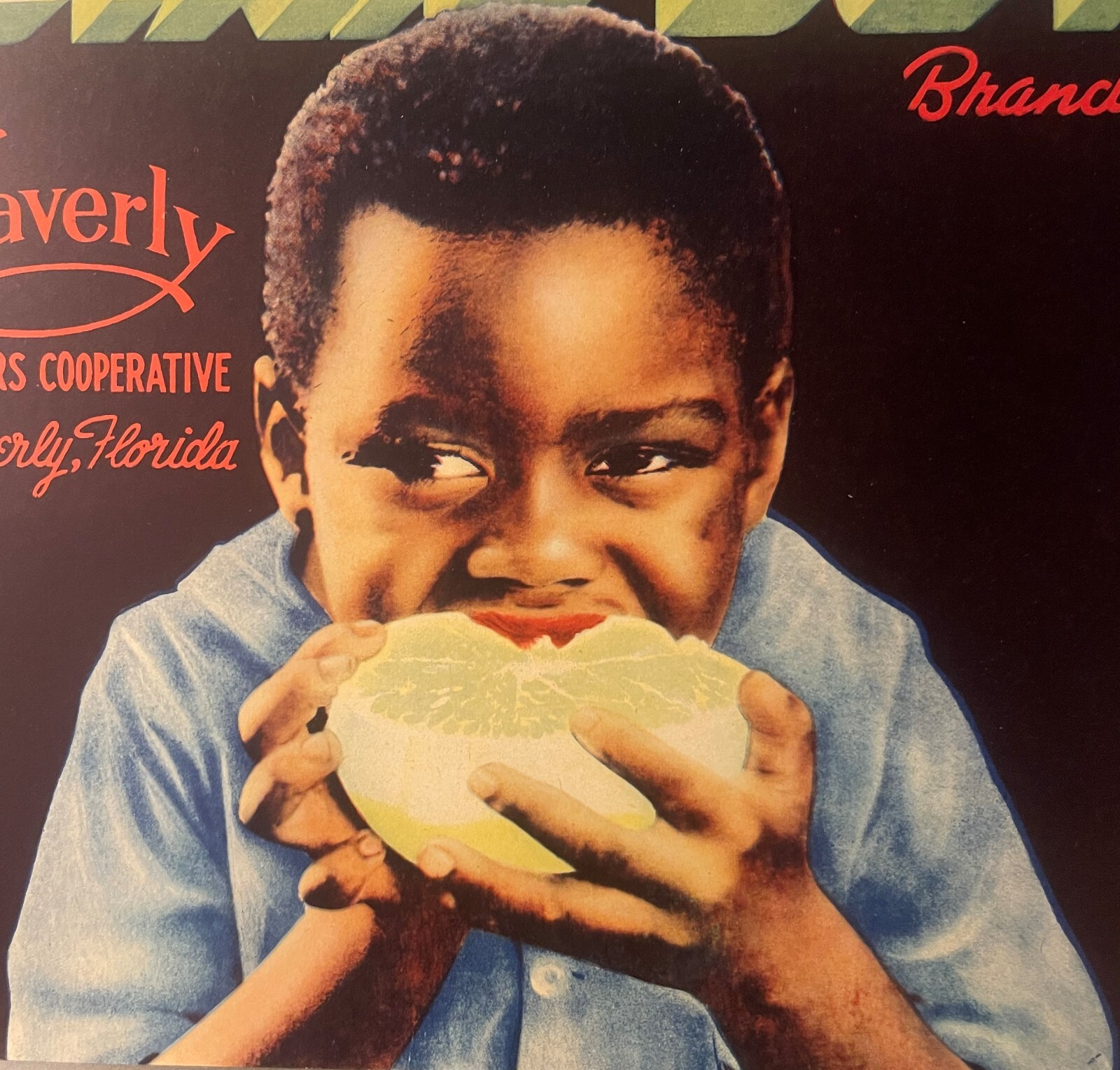
Citrus Crate Label, Waverly Growers Cooperative, Waverly, Florida
9" x 9" ~ little to no wear, new old stock, never pasted to a crate
Before refrigerated trucks and printed cardboard cartons, a paper label pasted to the end of a rough pine crate had one job: stop a produce buyer cold on a noisy warehouse floor and make him reach for this crate instead of the one next to it. This label did that job with a large, warmly lit photographic portrait - a boy in a blue collared shirt, caught mid-bite, both hands wrapped around a grapefruit half held right up to his mouth, eyes bright with delight. The photo is hand-color-separated in warm golds, creams and blues against a deep aubergine-maroon ground that reads almost black and makes the fruit glow against it. Above him, the brand name runs across the top in massive dimensional block lettering, cream letters cast with a heavy olive-green drop shadow. To the right, "Brand" is signed in loose red script, and down the left edge in the same red cursive: "Waverly" over a small stylized fish flourish, then GROWERS COOPERATIVE in block capitals, then "Waverly, Florida." That's the entire printed text - no fruit word, no net weight, no grade, no printed date, no printer's imprint.
The fruit itself is what's being read off the picture: a halved citrus fruit with pale yellow-green segmented flesh and a thick rind. The image bleeds straight to the trimmed edge with no border, and the back is plain, unprinted peach-tan stock.
🌱 The Cooperative Behind It
This cooperative has real roots in Florida citrus history. It was founded in 1914 by local growers led by Charles Hillery Walker and a Danish immigrant named W.L. Pedersen, who pooled their groves under the name the Waverly Citrus Growers' Association. For more than twenty years the association packed and shipped fruit under that name before formally renaming itself the Waverly Growers Cooperative in 1936 - the name printed right on this label, and a useful dating marker in its own right, since any label reading "Waverly Growers Cooperative" has to come from after that 1936 change. The cooperative grew into one of the more prominent shipping operations in Polk County, handling grapefruit, oranges, tangerines and tangelos from its member growers and moving them out by rail and truck to markets across the country.
Decades later, as the postwar boom in frozen concentrate and ready-to-drink orange juice pulled Florida's independent grower cooperatives together into bigger marketing organizations, this cooperative became one of the members of what became Citrus World in 1969 - known today as Florida's Natural Growers. That's a real, traceable line from this small, cheerful crate label to a Florida juice brand still on grocery shelves right now.
🌴 Waverly, Florida
Waverly sits in the heart of Polk County, in the ridge country that once held some of the densest citrus groves in the entire state. For much of the 20th century the town's identity and the cooperative's were one and the same, the way a mill town is its mill. Local historians tell of the packinghouse becoming something of a roadside attraction during Florida's big postwar tourism boom - postcards were printed of the welcome house and the packing lines, inviting travelers through Polk County to stop and watch fruit being sorted, washed and packed by hand. Local legend has it that visitors at the welcome house were greeted by women dressed as Southern belles, in the same theatrical spirit as the hostesses down the road at Cypress Gardens - showmanship laid over the very real, hardworking business of getting a grapefruit from a grove to a grocer's shelf hundreds of miles away.
That packinghouse era eventually wound down the way it did across the old citrus belt. In 2005 operations at the Waverly plant were taken over by the Haines City Citrus Growers Association, and by most accounts the old packinghouse buildings have stood quiet since.
👨🌾 The Growers Who Built It
Co-founder W.L. Pedersen was a Danish immigrant who built a life in Florida citrus, and became so central to the cooperative's operations that his 1950 obituary in a Lakeland newspaper specifically called it out. He and fellow founder Charles Hillery Walker represent the kind of grower-turned-businessman who actually built Florida's citrus cooperatives - men who knew their own trees personally and banded together with their neighbors because one grower alone had little leverage against the big packing and shipping interests, while a cooperative speaking for dozens of groves at once had real bargaining power in the produce markets up north.
🎨 How Labels Like This Were Made
From the late 1800s through the mid-20th century, wooden shipping crates were the standard way citrus traveled from Florida and California groves to markets nationwide, and every crate needed a label so buyers could tell one grower's fruit from another's on a crowded sale floor. What started as plain identifying labels evolved, decade by decade, into a real school of commercial art - colorful work produced by lithography houses competing for cooperatives' business. Early labels were printed by stone lithography, hand-separated color by color; by the era this label comes from, printers had shifted to photographic halftone screens combined with color offset lithography, letting artists blend a real photograph, like the boy pictured here, with hand-tinted color and bold hand-lettered type - exactly the technique on display in this design's dramatic lighting and heavy drop-shadow lettering.
The art form had a built-in expiration date: as wooden crates gave way to pre-printed cardboard cartons through the 1950s and beyond, the branding could just be printed straight onto the box, and the glued-on paper label's whole reason for existing disappeared. A label that never made it onto a crate - new old stock, like this one - is a particularly clean survivor of a vanished industry.
✅ Condition
New old stock, never used on a crate, little to no wear. Based on its printing technique - photographic halftone combined with bold drop-shadow lettering - and the fact that the cooperative renamed itself to "Waverly Growers Cooperative" in 1936, this label dates to the 1930s, after that renaming.
🖼️ Display Ideas
- Framed on its own as a bold graphic focal point in a kitchen or breakfast nook
- Grouped with other Florida citrus labels for a gallery wall
- Displayed in a Florida vacation home as a nod to the region's citrus heritage
- Matted with vintage postcards or citrus advertising ephemera
🎁 Good For
Florida memorabilia enthusiasts and Polk County local historians, Americana and vintage advertising collectors, farmhouse and kitchen decorators, and anyone with real roots in the old Waverly grove country.