When you click on links to various merchants on this site and make a purchase, this can result in this site earning a commission. Affiliate programs and affiliations include, but are not limited to, the eBay Partner Network.
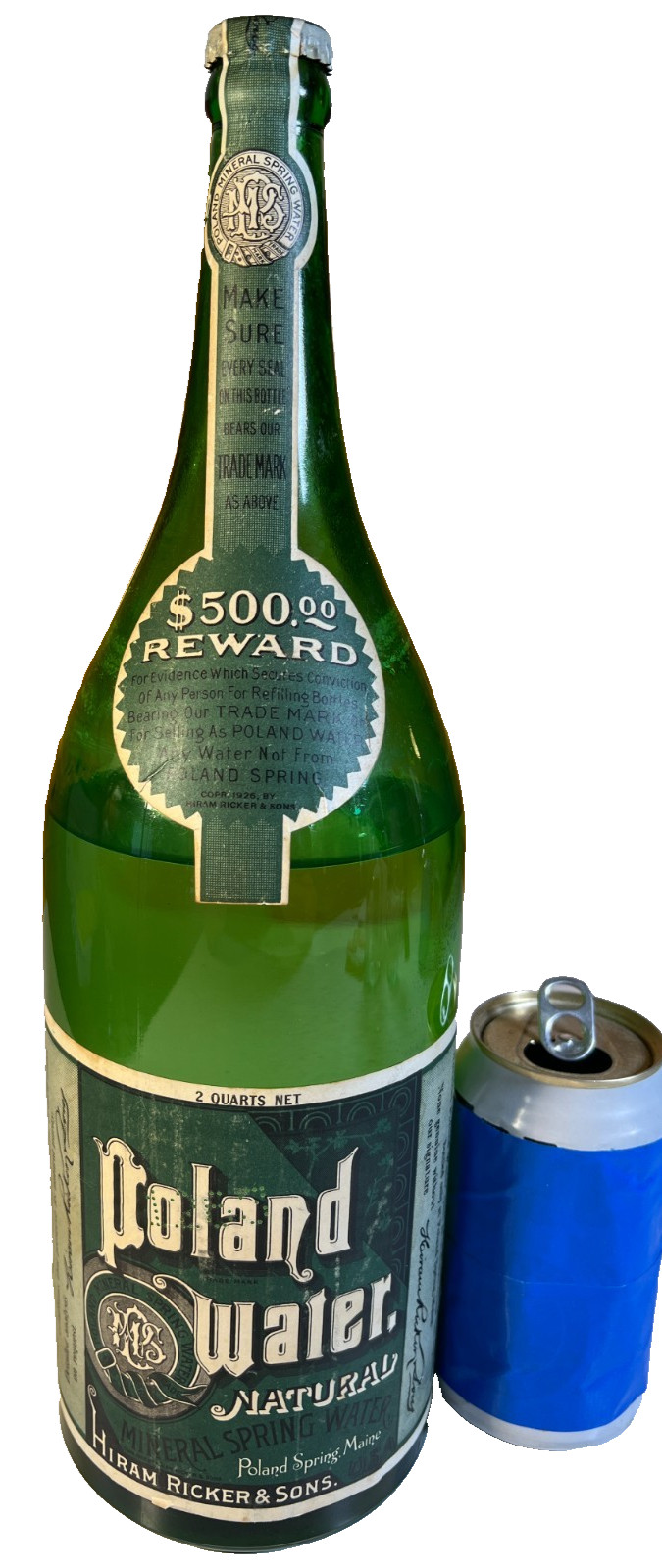
Antique 1926 Poland Spring Maine Sealed 2 Quart Mineral Water Bottle Full Label Original Contents !!
"A remarkable survivor from Maine's legendary Poland Spring. Still bearing its original 1926 neck seal, original cap, and approximately three-quarters of its original contents, this large emerald-green two-quart bottle remains virtually frozen in time. The dramatic '$500 Reward' anti-counterfeiting seal, Art Deco graphics, and visible mineral deposits left by nearly a century of slow evaporation make this one of the most evocative Poland Water bottles a collector could hope to find."
This is a spectacular survivor.
The neck seal is dated 1926 ("COPYR. 1926 BY HIRAM RICKER & SONS"), which gives us a firm earliest date. Based on the label style, prohibition-era packaging, and the ownership of the company, this bottle was almost certainly sold circa 1926–1932 from the famed springs in Poland Spring.
Why This Example Is Special
Most Poland Water bottles from this era survive as empty bottles with damaged labels. This one retains:
- Original paper body label
- Original neck seal
- Original cap
- Approximately 75% of the original contents
- Matching factory-applied tax/protection seal
- Crisp emerald-green glass
- Rare, LARGE, 2-quart size
- Original mineral water from the spring itself
The combination of all those factors is exceptionally uncommon.
The mineralization visible inside the neck and shoulder is exactly what collectors hope to see on an unopened example. Over nearly a century, a small amount of water slowly evaporated through microscopic pathways in the closure and paper seal, leaving dissolved minerals behind as a crystalline residue.
That mineral deposit is essentially a fingerprint proving the bottle has remained sealed for decades.
The Famous $500 Reward
The neck seal is fascinating.
It reads:
"$500 Reward"
for evidence leading to conviction of anyone refilling bottles bearing the Poland Water trademark.
A $500 reward in 1926 was serious money.
Adjusted for inflation, that's roughly $9,000–$10,000 today.
Poland Water had become one of America's most famous premium bottled waters. Counterfeiters and refillers were a real problem because customers associated the name with purity and prestige.
The company aggressively protected the brand.
Why The Label Has Little Cutout Dots
The tiny perforated-looking dots incorporated into the lettering and graphics served several purposes:
Anti-Counterfeiting
Complex dotted lithography was difficult for competitors to reproduce accurately.
Visual Sparkle
The dots simulated bubbles and effervescence, making the label appear more lively and premium.
Art Deco Influence
The label reflects late-1920s graphic design trends. The geometric patterns, shadows, and dot screens are classic Art Deco elements that were becoming fashionable during the period.
Printing Technology
The effect was created using halftone and stipple printing methods. Under magnification, many premium labels of the era reveal thousands of tiny printed dots.
About Poland Spring
The story begins in the 1790s when the spring was discovered in rural Maine.
By the late 1800s, Poland Spring had become one of America's premier resort destinations. Wealthy travelers arrived by rail to stay at the grand hotels surrounding the spring.
Guests included presidents, industrialists, writers, and prominent politicians.
The water itself was marketed as:
- Naturally pure
- Untouched by modern industry
- Bottled directly at the source
- Rich in beneficial minerals
By the 1920s, Poland Water was being shipped nationwide.
Life When This Bottle Was Filled
If this bottle dates from about 1926–1930:
- Roaring Twenties was in full swing.
- Prohibition was still in effect.
- Commercial radio was exploding in popularity.
- Air travel was still a novelty.
- Most rural Maine roads remained unpaved.
- A brand-new automobile might cost less than $700.
- Charles Lindbergh would soon make his famous Atlantic crossing.
- The stock market crash and onset of the Great Depression were just around the corner.
Yet someone purchased this bottle, never opened it, and somehow it survived nearly 100 years.
Condition
From the photos:
Glass
- Excellent condition
- No visible cracks
- No obvious damage
- Strong emerald coloration
Labels
- Remarkably complete
- Moderate age toning
- Excellent readability
- Neck seal intact
Contents
- Approximately 3/4 full
- Expected mineral deposits from long-term evaporation
- Authentic period appearance
Cap
- Original cap appears present beneath seal