When you click on links to various merchants on this site and make a purchase, this can result in this site earning a commission. Affiliate programs and affiliations include, but are not limited to, the eBay Partner Network.
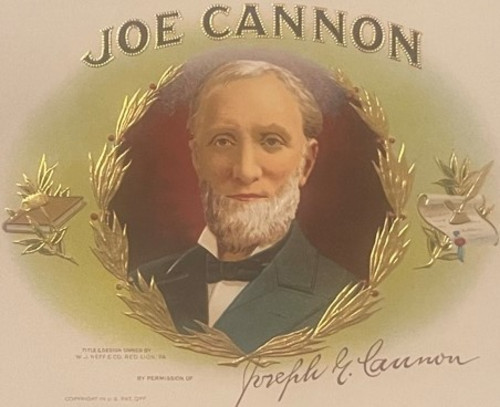
Why Did Uncle Joe Cannon Make a Terrific Cigar Brand? 🎩 Joe Cannon Cigar Box Label, Uncle Joe, Speaker of the House, W. J. Neff & Co. Red Lion Pa, Unused
Size: 8 1/2\" x 7 1/2\" ~ unused ~ little to no wear
Inner lid label: Speaker Joseph G. Cannon\'s portrait in an embossed gold laurel wreath, his facsimile signature, JOE CANNON in beaded gold letters top and bottom. A closed book with a quill sits left of the wreath, and on the right a scroll with an inkwell, a quill and a red wax seal. You\'ll get one like the one shown. The embossing goes right through, so the pattern is felt on the reverse, and the label reads \"By permission of\" above the signature.
Uncle Joe
Cannon (1836-1926) served 23 terms in the House from Danville, Illinois, and was Speaker 1903-1911. He came into the world in Guilford County, North Carolina, on May 7, 1836, and his Quaker family took him west to Indiana in 1840. As a young man he studied law in the Terre Haute office of John Palmer Usher, who went on to be Lincoln\'s Interior Secretary, then put in six months at the Cincinnati Law School and was admitted to the bar in 1858. He settled in Tuscola, Illinois, in 1859 only because his money gave out on the train, and in 1876 he brought his family to Danville for good.
Voters first sent him to Congress in 1872. His House career ran 46 years between 1873 and 1923, in three stretches: 1873-1891, 1893-1913 and 1915-1923. On his last day in office, March 3, 1923, he was on the cover of Time\'s first issue. He died in Danville on November 12, 1926, aged ninety. Since 1962 his name has been on the Cannon House Office Building, and North Carolina\'s 1949 highway marker in Greensboro notes that his birthplace stood a mile and a half off.
Czar Cannon
The nickname was earned. As Speaker he appointed every committee chairman and every committee member, and the Speaker of that day also headed the Rules Committee, the body that settled how bills were debated and voted on and which ones ever saw the floor. He ranks with the most powerful Speakers in House history.
The 1910 revolt led by George Norris took the Rules Committee from him. Norris, a Nebraska Republican, brought up his resolution on St. Patrick\'s Day, March 17, when many of Cannon\'s backers were missing, and on March 19, 1910, the House adopted it 191 to 156 - all 149 Democrats plus 42 Republicans. Cannon branded it \"anarchy under the color of law,\" invited a motion to vacate the chair and beat it easily, since the Republican majority would not risk a Democratic Speaker. He held the gavel until 1911, but the grip was gone.
Cannon lost his seat in 1912, when Theodore Roosevelt\'s Progressive Party split the Republican vote: the Progressive candidate drew 19 percent in his district and Democrat Frank O\'Hair of Paris, Illinois, finished first with 38.9 percent against Cannon\'s 37.3. Cannon regained the seat in 1914.
A Face for a Cigar Box
The white beard and black cigar made him a cartoonist\'s dream. He was folksy and profane (\"foul-mouth Joe\"), liked poker and a good line, and enjoyed being in the papers. In a 2013 article on congressional cigar labels, the House\'s Office of the Historian wrote that Uncle Joe \"made a terrific cigar brand\" and that the gavels, quill pens, laurel wreaths and gold embossing on his labels gave his hayseed manner a dignity his public image lacked. This one has the laurel, two quills and plenty of gold. Collectors like to say the rough-and-ready Uncle Joe on a fancy gold label was half the fun.
Dating It
The foot line reads Consolidated Lithographing Corporation, Brooklyn, N.Y. Consolidated was formed in 1926 through its purchase of Pasbach-Voice and stayed in Brooklyn until 1952. The \"Copyright in U.S. Pat. Off.\" line dates from before 1940: labels had been registered at the Patent Office since 1874, and the work passed to the Copyright Office on July 1, 1940. So this printing is 1926-1930s. The Cincinnati Art Museum holds the same label. A different Joe Cannon label, the \"National Speaker,\" also exists; this one is the portrait version.
About the printer: in January 1935 Time magazine named Consolidated the world\'s biggest cigar-band maker, supplying roughly 70 percent of the bands on U.S. cigars made in 1934 that carried one. President Jacob A. Voice started at 14 as a bronze feeder at the William Steiner & Co. lithograph house, later set up a small lithograph firm with friends that thrived when World War I shut off German lithographic supplies, and merged with Steiner in 1926. Vice-president Sidney Voice collected bands and labels; his collection, about 1890-1963 and including salesmen\'s sample books from New York and Brooklyn lithographers, is at the New-York Historical Society.
Red Lion, Pa.
Title and design owned by W. J. Neff & Co. of Red Lion, Pa., the town that by 1927 had 109 cigar factories and made a fifth of America\'s nickel cigars. Red Lion is in York County, Pennsylvania, and its brands included Tennessee River Crooks and Mark Twains. Much of the work began in family basements, with parents and children rolling at home. The town\'s first cigar factory was a basement shop too: Nathaniel Neiman opened it after arriving in 1873, and his wife, daughter of Dr. John Hermann of Windsor Township, ran it. The Depression, cigarettes, machines and a violent 1934 strike all hurt the trade. During that strike women lay across a driveway to block the trucks, police used billy sticks and tear gas, and calling in the Pennsylvania National Guard was discussed.
The Lore
Danville legend has it his hometown bought Joe Cannon cigars by the box as gifts while he was Speaker. It\'s said that makers rushed to get Cannon onto their boxes in the Czar years, since his name was sure to start an argument at any saloon or tobacco counter, and Danville\'s tobacconists are said to have stocked his cigars well after the 1910 revolt. In Red Lion\'s boom years, the story goes, every downtown block had a rolling shop, box maker, label printer or tobacco dealer.