When you click on links to various merchants on this site and make a purchase, this can result in this site earning a commission. Affiliate programs and affiliations include, but are not limited to, the eBay Partner Network.
🚢 What did it feel like to hold a piece of paper backed by J.P. Morgan himself — a stake in the very trust that owned the Titanic?🌊
There's a particular kind of chill that comes from unfolding a stock certificate and realizing the company named across the top once owned the most famous ship that ever sailed. Long before anyone had heard of an iceberg in the North Atlantic, financiers in mahogany-paneled offices on Wall Street were quietly buying up entire fleets of ocean liners, stitching together a shipping empire meant to rule the seas the way steel and rail already answered to Pittsburgh and New York.This certificate is a surviving piece of that empire — engraved, printed, issued, and eventually retired, but never forgotten by the collectors and maritime historians who still hunt these down today.
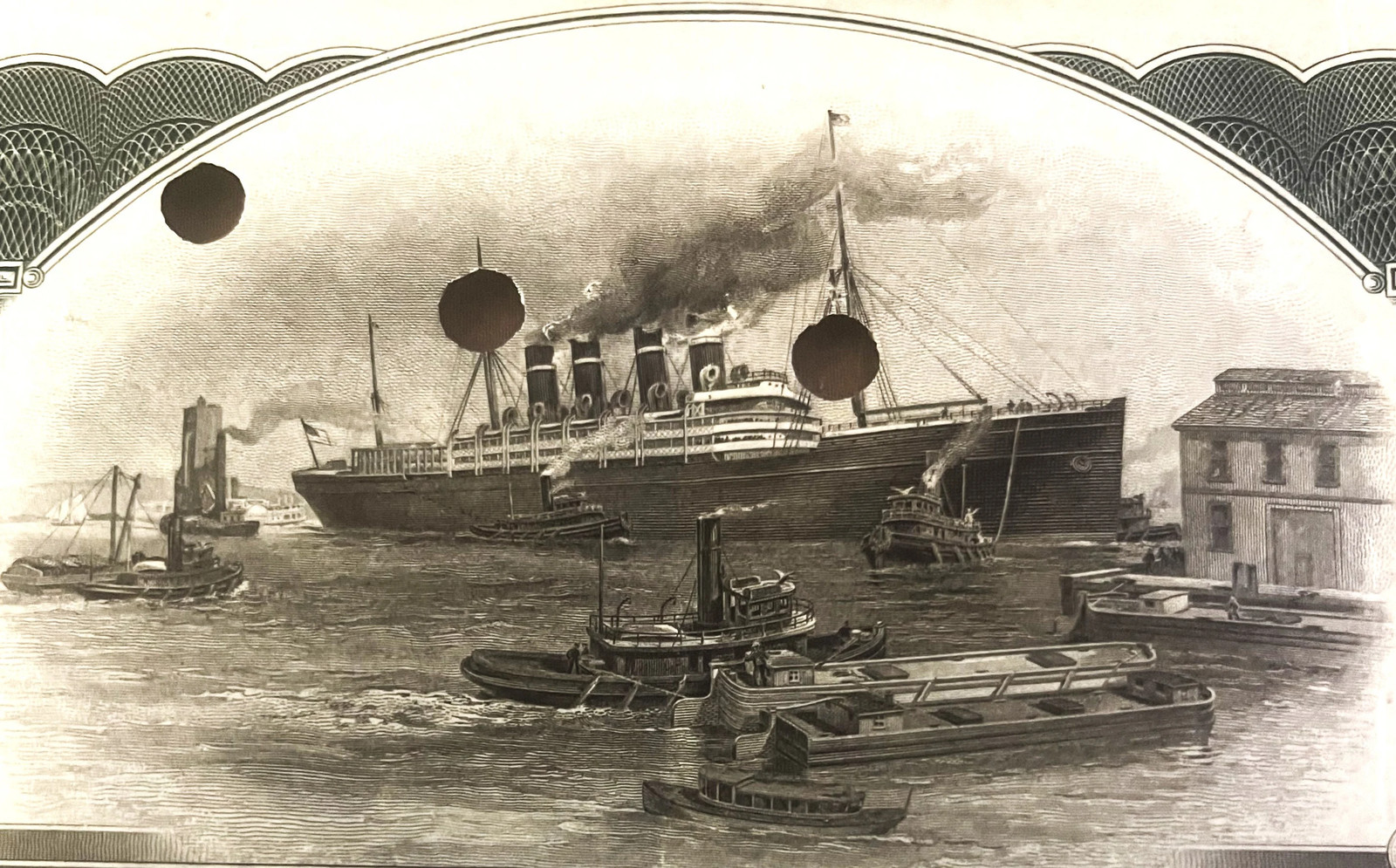
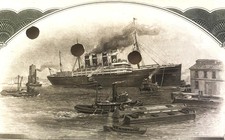
What you're looking at is an original common capital stock certificate of the International Mercantile Marine Company, a shipping trust incorporated under the laws of the State of New Jersey, engraved and printed by the American Bank Note Company of New York.The design carries the printer's confident hand — a steel-engraved intaglio vignette finished with a letterpress overprint of the certificate's legal text, rendered in a warm palette of brown and cream with the central image worked in sepia and black. That vignette is the heart of the piece: a four-stack ocean liner trailing a great plume of smoke, tugboats and cargo barges working the harbor around her, a waterfront building anchoring the pier, and below the corporate title, a graceful seated allegorical female figure resting against a ship, rendered in the same sepia hand-engraved style.Across the top, ornate scrollwork frames the printed language every certificate of this type carries — "This Certifies that... is the owner of... shares... Common Capital Stock... of International Mercantile Marine Company," with corner medallions stamped "Certificate for Less Than 100 Shares." The steel-engraved vignette and ornate scrollwork borders are typical of early 20th-century American Bank Note Company stock certificates, consistent with the 1910s–1920s.As was standard corporate and banking practice of the period, certificates like this one were issued and later retired through punch-cancellation — small cancellation holes worked directly through the printed design, marking the shares as redeemed rather than active. That's original to the piece and part of its story, not a flaw to be graded — simply how Wall Street closed the books on a certificate once it had done its job.
🏦 J.P.Morgan's Ocean Trust
The International Mercantile Marine Company was one of the boldest — and most notorious — financial gambles of the early twentieth century. The combine was formally announced by J. Pierpont Morgan in London in April 1902, with the company incorporated in New Jersey that October, exactly as this certificate's own printed header declares.Morgan's ambition was staggering in scope: buy up the great transatlantic passenger and freight lines one by one, British and American alike, and weld them into a single corporate trust that could dictate terms on the North Atlantic the way Morgan's other combines already dominated steel and rail. The company was capitalized to match that ambition — reportedly more than $50 million in bonds alone, on top of roughly $60 million in preferred stock and additional common stock, a securities package totaling something on the order of $120 million, an almost unimaginable sum for a shipping venture at the turn of the century.
Because Morgan was an American financier, he could not directly own British-flagged vessels — so instead he built a holding company that owned the companies that owned the ships.It's easy to imagine the boardroom logic: rather than build a single new liner, buy every rival fleet already crossing the ocean and let the combine's sheer size do the rest. In its first full year of operation, IMM's constituent lines carried over sixty thousand passengers, a business swollen by the enormous wave of transatlantic immigration flowing into the United States in that era — steerage tickets by the thousands, filling ships that Morgan's trust now controlled from the top down.
⚓ The Men Who Built It — and the One Who Survived
IMM wasn't Morgan's brainchild alone.The combine was assembled by shipping men who each brought a fleet to the table: Clement A. Griscom of the American Line and Red Star Line, Bernard N. Baker of the Atlantic Transport Line, John Ellerman of the Leyland Line, and — most consequentially for history — J. Bruce Ismay of the White Star Line, whose Dominion Line was folded in as well.Griscom served as IMM's first president from 1902 to 1904, at which point Ismay, who was already president of White Star itself, took the helm of the parent trust as well, holding the presidency until 1913.
It is Ismay's name that ties this certificate most directly to the ship every collector in this category is really thinking about.As president of both White Star and its parent IMM, Ismay was aboard the RMS Titanic on her maiden voyage in April 1912, and he survived the sinking — pulled aboard a lifeboat while so many others did not, and later brought to New York aboard the rescuing Cunard liner Carpathia. History has never been entirely kind to him for it; the controversy over his survival followed him for the rest of his life, and he largely withdrew from public view in the years afterward.Whatever judgment history renders on the man, his signature and his presidency sit at the very center of why a stock certificate from this company carries so much more weight than an ordinary piece of Gilded Age financial paper.
🛳️ The White Star Line and the Ship This Trust Made Famous
The White Star Line — formally the Oceanic Steam Navigation Company — was IMM's single most prestigious holding, and for a long stretch of its history it was a wholly owned subsidiary of the trust this certificate represents.It was, by most accounts, the most successful and celebrated of the British transatlantic carriers of its era, and it was White Star's own RMS Titanic that made the International Mercantile Marine Company a name remembered more than a century later — not for its balance sheets, but for the single most famous maritime disaster in history.Every certificate bearing the IMM name is, in that sense, a piece of paper from the front office of the company that ordered, owned, and operated the ship whose story never really faded from public imagination.
📉 Rivalry, Struggle, and the Long Wind-Down
Morgan's ocean trust cast a long shadow the moment it was announced — enough of one that it triggered a genuine panic among British shipping interests and prompted the British government itself to step in, subsidizing Cunard Line's construction of two new superliners, the Lusitania and the Mauretania, specifically to keep pace with the American-backed combine.It's a remarkable footnote of maritime history: two of Cunard's most famous ships exist, in part, because a government felt it had to answer Morgan's ambitions with ships of its own.
But the trust itself never achieved the dominance Morgan envisioned. IMM had dramatically overpaid to acquire the fleets it swallowed up, based on profit projections that never quite materialized, and a proposed subsidy bill that might have shored up its American operations failed in Congress.The company limped rather than sailed through much of its corporate life. In the years following, the White Star Line itself passed out of IMM's direct ownership by the late 1920s, and by the early 1930s the parent company was deep into reorganization — merging with the Roosevelt Steamship Company to form a new entity, absorbing the troubled United States Lines, and dissolving what remained of the old Atlantic Transport Line into its surviving divisions.By the middle of that decade, Cunard had acquired what remained of White Star outright, and IMM's American assets folded into the United States Lines banner for good — closing the book on the trust Morgan had assembled with such fanfare three decades earlier.
🖋️ The Engraver's Art — American Bank Note Company
The craftsmanship behind this certificate deserves its own telling.The American Bank Note Company traces its roots to 1795, founded originally as Murray, Draper, Fairman & Company, and it grew alongside the young nation's expanding banks and financial institutions. Following the Panic of 1857, seven of the country's most prominent security printing firms merged in 1858 to form the American Bank Note Company outright, headquartering the new firm in New York City — for a time in the Merchants Exchange Building on Wall Street, placed deliberately within easy reach of the stock exchanges, brokerage houses, and banks of lower Manhattan.From that address, the company became the young country's premier engraver of paper currency for state-chartered banks, United States postage stamps, and — most relevant to this piece — the ornate stock and bond certificates that Gilded Age and early twentieth-century corporations relied on to represent ownership on paper.The steel intaglio engraving process the firm used was prized precisely because it was so difficult to counterfeit, and the elaborate scrollwork, allegorical figures, and finely detailed vignettes weren't just decoration — they were security features, a visual signature of a legitimate, well-capitalized company that could afford the finest engraving house in the country.
💭 What It Means to Hold One Today
Stock and bond collecting — scripophily, as the hobby is formally known — has always drawn people who love history as much as finance, and certificates tied to the Titanic story sit near the top of that hobby's most sought-after ground.This piece speaks to two collecting worlds at once: the Wall Street financial historian tracing the era of trusts, combines, and Morgan-style consolidation, and the Titanic enthusiast for whom the White Star Line and its parent company are inseparable from the ship itself. Few pieces of period paper let you hold both stories in one hand.
🖼️ Display Ideas
- 🖼️ Framed alongside White Star Line or Titanic-era ephemera for a maritime history wall
- 📚 Matted with a magnifying glass nearby so guests can study the engraving up close
- 🧭 Displayed near model ships, ocean liner postcards, or vintage travel posters
- 💼 A conversation piece for a home office or library shelf devoted to Gilded Age finance
- 🎓 A teaching piece for anyone interested in early twentieth-century corporate history and the birth of American trusts
- 🕰️ Paired with other American Bank Note Company engraved certificates to showcase the printer's craft across different companies
🎁 Who Collects These
This certificate draws interest from several directions at once — scripophily collectors who specialize in early twentieth-century American trusts and railroad-and-shipping combines, maritime history buffs and Titanic enthusiasts building out a collection around the White Star Line, and anyone drawn to J.P.Morgan and the Gilded Age story of American finance more broadly. It also appeals simply as a striking piece of engraved paper art — the harbor vignette and allegorical figure hold up on their own even for someone who's never heard of the International Mercantile Marine Company before encountering this piece.
❓ FAQ
Is this connected to the actual Titanic?
The International Mercantile Marine Company was the parent corporation of the White Star Line, owner and operator of the RMS Titanic.This certificate represents ownership in that parent trust, not in the ship itself, but the corporate line runs directly from this paper to that history.
Who printed this certificate?
The American Bank Note Company of New York, one of the era's premier security engravers, known for its steel intaglio printing on currency, postage stamps, and corporate stock certificates.
What era is this certificate from?
The steel-engraved vignette and ornate scrollwork border style are consistent with early twentieth-century American Bank Note Company work, generally placing certificates of this type in the 1910s–1920s.
Is this an issued or cancelled certificate?
Certificates of this type were issued to shareholders and later retired through punch-cancellation, a routine part of corporate and transfer-agent record-keeping of the period.Cancellation marks are original to the document.
What does the vignette depict?
A four-stack ocean liner underway in a busy harbor, attended by tugboats and cargo barges, with a waterfront building at the pier and a seated allegorical female figure beneath the company title.
Was this company successful?
Not in the way Morgan originally hoped.IMM overpaid to assemble its fleets, never achieved the market dominance projected, and spent much of its later corporate life in reorganization before its American operations were absorbed into United States Lines and its British holdings passed to Cunard.
Is this a good gift for a Titanic or maritime history collector?
Very much so — it's a genuine period financial document tied directly to the corporate history behind the White Star Line, making it a meaningful piece for anyone already collecting in this space.