Arts (125)
    Asian & African (8)
    Books (560)
    Boxes & Tea Caddies (85)
    Clocks (36)
    Decorative (398)
    Dolls & Bears (122)
    Figurines (530)
    Furniture (24)
    Glass (1736)
  ...
View All


Search our
Dealer/Mall
Stores!


Poodle, Spaghetti Trim, Ucagco


Collector Books

The Journal of Antiques and Collectibles


Antique πŸš‚ 1893 Big Four Railroad $1000 Gold Bond - Bond Only, No Coupons For Sale


Antique πŸš‚ 1893 Big Four Railroad $1000 Gold Bond - Bond Only, No Coupons
When you click on links to various merchants on this site and make a purchase, this can result in this site earning a commission. Affiliate programs and affiliations include, but are not limited to, the eBay Partner Network.


Buy Now

Antique πŸš‚ 1893 Big Four Railroad $1000 Gold Bond - Bond Only, No Coupons:
$17.95

πŸš‚ What did $50,000,000 in Gilded Age railroad promises actually look like on paper?

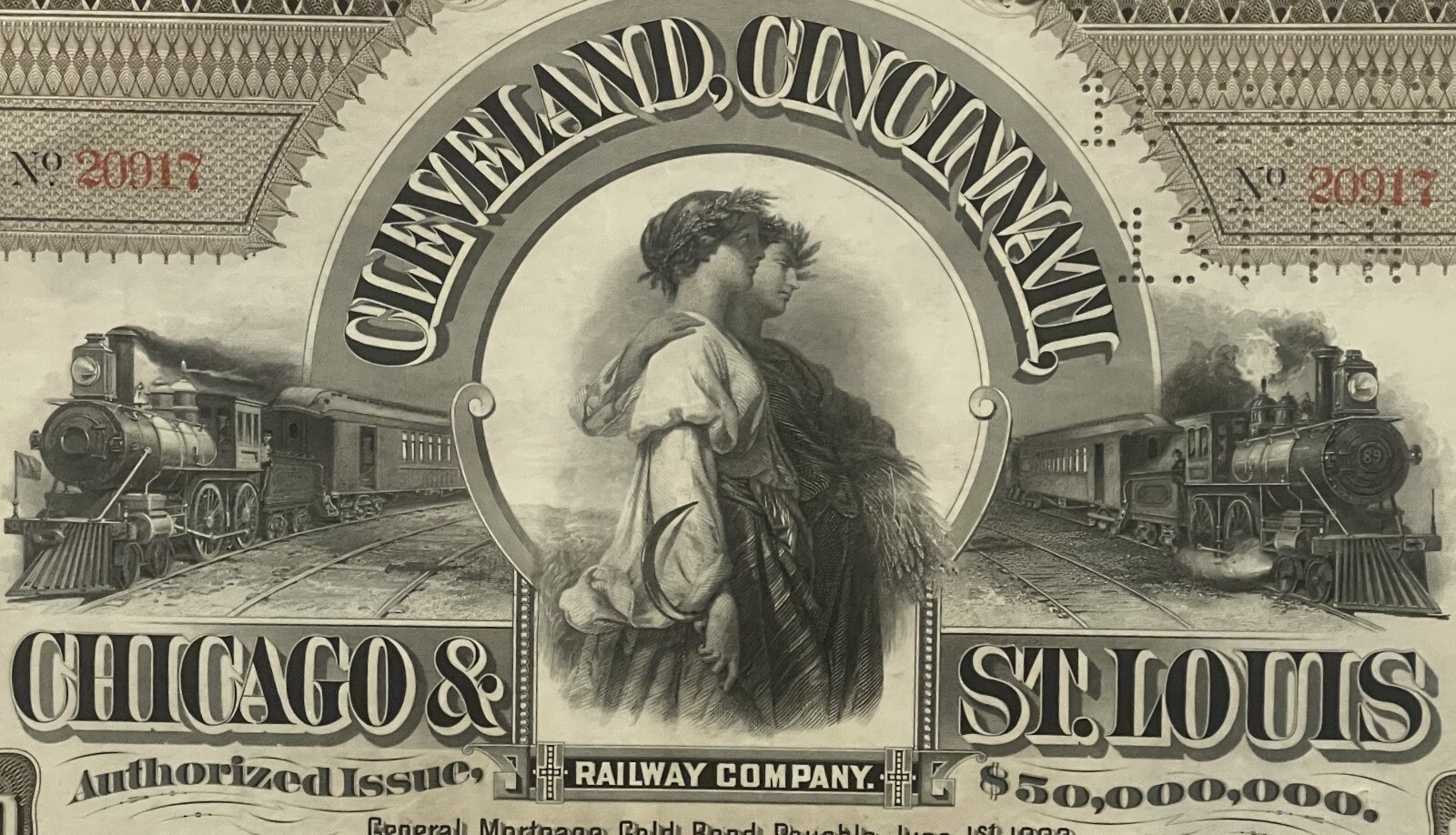
It looked exactly like this. Long before electronic ledgers and book-entry securities, a railroad raising serious capital had to print its promise β€” engraved, signed, sealed, and handed to an investor who trusted a steam locomotive and a strip of steel rail more than he trusted most banks. This is one of those promises: a $1,000 General Mortgage Gold Bond of the Cleveland, Cincinnati, Chicago & St. Louis Railway Company, better known across the Midwest simply as "the Big Four." Old-timers in railroad towns from Indianapolis to Bellefontaine still tell stories about this line, and holding one of its actual bond certificates is about as close as a collector gets to shaking hands with the Gilded Age.

This certificate was issued by the Cleveland, Cincinnati, Chicago & St. Louis Railway Company, a corporation existing under the laws of Ohio and Indiana, and engraved and printed by the American Bank Note Company of New York β€” the preeminent security printer of the era, the same firm entrusted with currency-grade engraving work for railroads, banks, and government issues across the country. The bond is dated to its 1893 issue, part of a General Mortgage Gold Bond series secured by a mortgage dated May 15, 1893, running one hundred years to a June 1, 1993 maturity, at four percent interest payable each June and December against the small coupons once clipped and redeemed at the company's New York agency. Trust for the issue was held by the Mercantile Trust Company of New York. Measuring a substantial 15 x 10 inches (about 38 x 25.5 cm) on heavy cream and tan security stock, the certificate is a striking piece of engraving: a tall arched title reading "CLEVELAND, CINCINNATI, CHICAGO & ST. LOUIS" in bold black lettering, framing a central oval vignette of two classically robed allegorical women crowned in laurel, one cradling sheaves of wheat and a crescent moon, flanked on either side by facing steam locomotives pulling passenger cars down parallel tracks. Red serial numbering, an ornate engine-turned guillochΓ© rosette worked into the lower field as an anti-counterfeiting device, and manuscript officer signatures in gold-brown period ink complete the piece. This is a genuine issued bond β€” executed in ink by the railway's officers under an embossed seal, certified by the trustee, entered on the reverse registry panel, and punch-cancelled when it was retired.

πŸ’° The "Big Four": One Railroad, Four Cities, One Empire

Here's a piece of trivia that trips up even seasoned collectors: the "Big Four" nickname didn't refer to four separate railroads merging together β€” it referred to the four cities strung across this single company's name: Cleveland, Cincinnati, Chicago, and St. Louis. The railroad itself was born June 30, 1889, from the consolidation of the Cleveland, Columbus, Cincinnati and Indianapolis Railway, the Cincinnati, Indianapolis, St. Louis and Chicago Railway, and the Indianapolis & St. Louis Railway β€” three regional lines fused into one Midwestern trunk system spanning Illinois, Indiana, Michigan, and Ohio. Within a year the new company had also absorbed the former Indiana, Bloomington and Western Railway.

Its lineage runs even deeper. One ancestor line traces to the 1848 charter of the Indianapolis and Bellefontaine Railroad. Another reaches back to 1835 and the Mad River & Lake Erie Railroad β€” Ohio's very first railroad, laid down when the state was still mostly forest and farmland. By the time this bond was engraved in 1893, the Big Four represented decades of consolidated Midwestern rail ambition, all folded under one corporate banner and, notably, under Vanderbilt ownership. Though it remained a technically independent corporation for years, the Big Four operated from early on as part of the Vanderbilt-controlled New York Central system β€” which is exactly why a railroad named for four Midwestern cities issued its gold bonds payable at an agency in New York City, and why American Bank Note Company of that same city did the engraving. A $50,000,000 authorized issue was an enormous sum for 1893 β€” real testimony to how much capital it took to knit together a Gilded Age rail network stretching across four states.

πŸ™οΈ Indianapolis, Not Cleveland: Where the Big Four Actually Lived

Despite Cleveland leading the name, the railroad's operating heart beat in Indianapolis. The company's headquarters eventually settled into the Chesapeake Building at 105 South Meridian Street β€” built for the railroad in 1929 and long known locally simply as the Big Four Building, before it was reborn as a hotel decades later. Between 1904 and 1908 the company also built a major repair shop complex at Beech Grove, Indiana, a facility whose story didn't end with the railroad itself. And out east in Bellefontaine, Ohio, the Big Four operated a terminal boasting what was, in its day, the largest roundhouse between New York City and St. Louis β€” a genuine point of local pride for a small Ohio rail town that punched well above its weight in the national network.

Local legend around these old Big Four towns holds that engineers and shopmen took real pride in working for "the Big Four" specifically because it wasn't some anonymous trunk line β€” it was assembled from railroads that Midwestern towns had literally built for themselves a generation earlier, and old-timers in Bellefontaine are said to have measured their town's standing by the size of that roundhouse for decades after the Big Four name itself had faded from timetables.

πŸ–‹οΈ The Men β€” and the Engraving β€” Behind the Paper

Melville E. Ingalls presided over the Big Four from 1889 until 1905, guiding the company through essentially its entire life as a nominally independent corporation β€” squarely the era in which this 1893 bond was issued. Ingalls was known as a hands-on executive; local lore recalls that in 1901 he personally rejected an elaborate depot design submitted by a well-regarded Cincinnati architect, sending it back to the railroad's own engineering department with instructions to draw up something simpler instead β€” a small story, but one that says a great deal about how tightly the Big Four's leadership controlled its own image, right down to its depots and, one imagines, its finely engraved gold bonds.

The vignette itself carries its own passed-down lore among engraving and scripophily collectors. Many who study early American Bank Note Company work identify this style of classical harvest scene β€” laurel-crowned allegorical figures amid sheaves of wheat, flanked by twin locomotives β€” with the celebrated "Reapers" engravings, said to have been cut by a teenage American Bank Note engraver in the 1870s and prized ever since as some of the most detailed vignette work the firm ever produced for railroad securities. Whether or not every detail of that studio story survives in the record, collectors of railroad scripophily and bank note engraving have long passed the tale along, and it's part of why bonds carrying this exact artwork are so sought after β€” the engraving is simply a cut above the routine bond vignette.

πŸ›€οΈ From Steam Rails to Bike Trails: The Big Four's Legacy Today

The Big Four's corporate life followed the classic arc of American railroading: absorbed by the New York Central in 1906, formally leased to NYC for ninety-nine years in 1930, folded into the ill-fated Penn Central merger of 1968, rescued into the government-formed Conrail in 1976, and finally split between CSX and Norfolk Southern when Conrail was divided in 1997. Along the way, pieces of the Big Four's physical footprint have quietly outlived the company's name. That Beech Grove repair shop Amtrak purchased out of the bankrupt Penn Central in 1975 and still operates today as one of its principal heavy-maintenance facilities. And a bridge the Big Four acquired across the Ohio River at Louisville in 1895 was reborn in 2014 as the Big Four Bridge pedestrian and bicycle crossing β€” now one of Louisville's most beloved public landmarks, still carrying the Big Four name a century and a half after this bond was engraved, just no longer carrying trains.

Paper bonds like this one simply aren't made anymore β€” railroad financing today lives entirely in electronic book-entry systems, with none of the engraved artistry, wax seals, or hand-signed officer ink that Gilded Age investors expected as proof of their stake. Every surviving certificate is a one-time physical artifact of exactly how railroad capital used to be raised, held, and traded.

πŸ–ΌοΈ Display Ideas
  • πŸš‚ Framed solo in a deep shadow box for a den, home office, or dedicated train room
  • πŸ›οΈ Matted alongside a map of the Big Four's Ohio–Indiana–Illinois–Michigan routes for a library wall
  • πŸ“œ Paired with other scripophily pieces to build a themed Gilded Age railroad finance collection
  • πŸ–‹οΈ Displayed to highlight the guillochΓ© rosette and vignette engraving for security-print and bank note enthusiasts
  • πŸŽ“ Given as a milestone gift to a railroad history buff, financial historian, or genealogist tracing Midwestern rail-town roots
  • 🏒 Hung in a corporate or law office lobby as a conversation-starting nod to American industrial finance
🎁 Who Collects These

Scripophily collectors β€” those who specifically hunt down historic stock and bond certificates β€” treat railroad gold bonds like this among the classics of the hobby, prized for their engraving quality and their tie to named, traceable American corporations. Railroadiana enthusiasts chase them for the same reason they chase timetables and builder's plates: tangible proof of a specific, storied line. Engraving and bank note print collectors seek out American Bank Note Company work in particular for its craftsmanship. And more casual buyers β€” gift-givers looking for something with real weight and a real story for a train-loving relative, a history teacher, or a finance-minded collector β€” find in a piece like this something a modern print or reproduction simply can't offer: an original artifact of Gilded Age American enterprise, sized and finished for proud framing.

❓ FAQIs this an original bond, or a reprint?

It's a genuine issued certificate from the company's own printed issue β€” executed, registered and cancelled β€” not a modern reproduction.

Was this bond ever actually paid out for real gold?

The bond's own text promises payment "in gold coin of the United States of the present standard of weight and fineness" β€” standard Gilded Age language for a gold-backed corporate bond, reflecting the hard-money financing standards railroads operated under in the 1890s.

What's the difference between a bond sold alone versus one with coupons attached?

Across surviving examples of this issue, some appear as the bond alone, while others retain part of the original coupon strip along the edge β€” the small interest "tickets" investors once clipped twice yearly, each June and December, and presented for payment. Both are entirely genuine forms of the same historical instrument.

Coupons were made to be clipped away, and most bonds of this age lost theirs one payment at a time until only the certificate was left, so a sheet that came through the decades still attached is the exception rather than the rule. When a road went under, holders commonly taped the last coupon back onto the bond and held on in hope of collecting what they were owed, so a bond that still carries that taped final coupon is the better one to end up with. The coupon count can run a few more or a few fewer than what is pictured.

Why does a railroad named for Cleveland run its bonds out of New York?

The Big Four operated as part of the Vanderbilt-controlled New York Central system from early in its history, which is why its finance agency, its bond payments, and its engraving all ran through New York even while its rails and shops sat squarely in the Midwest.

Who was American Bank Note Company?

The New York firm responsible for engraving and printing this bond, American Bank Note Company was among the most trusted security printers in the country during this era, producing currency-grade intaglio engraving for railroads, banks, and government bodies alike.

How should I care for and display a piece like this?

Most collectors frame these under UV-filtering glass or acid-free matting out of direct sunlight, which lets the engraving and the vignette artwork stand out beautifully while protecting the piece long-term.

Does the size match what's shown in the photos?

Yes β€” this is a full-size certificate measuring 15 x 10 inches (about 38 x 25.5 cm), consistent with the substantial security paper railroads used for their formal bond issues.

These are issued instruments rather than blanks. Bonds and debentures of this type were registered to a holder, authenticated by the trustee, and punch- or cut-cancelled when they were finally redeemed. Expect financial writings, markings, stamps, hole punches and staple holes as part of the life of the instrument: endorsements and signatures, trustee and registrar stamps, revenue or documentary tax stamps, cancellation punches, staple holes from being bound into a transfer book, pencil ledger notations. That is the paper trail of a security that actually did its job, and it is what separates a document that lived from a blank that never did. No two are alike: holder details, serial numbers, dates, signatures, stamps and punch patterns vary from example to example, so the photographs show the type rather than the exact sheet that ships. The coupon count can run a few more or a few fewer than pictured.


Buy Now


Related Items:

Lot Of 125 Vintage Style Antique Skeleton Furniture Cabinet Old Lock Keys Jewelr picture

Lot Of 125 Vintage Style Antique Skeleton Furniture Cabinet Old Lock Keys Jewelr

$10.99


Antique Large Polychromed Wooden SpanishBaroque Santos C 1800th 30” High picture

Antique Large Polychromed Wooden SpanishBaroque Santos C 1800th 30” High

$3200.00


YSL Antique Bronze Gold Brooch Hat Scarf Tie Collar Lapel Pin Saint Laurent picture

YSL Antique Bronze Gold Brooch Hat Scarf Tie Collar Lapel Pin Saint Laurent

$47.00


  Shopping Cart 
(Your shopping cart is empty)
Subtotal: $0.00
View Cart | Checkout


  Recently Viewed

1.  Lacquered Cedar Wood Box
2.  The White Horse Established 1742 Sign Signed
3.  Pewter Framed Tile, Plate. Ship, Sailing


  Latest Items

1.  Basket, Handpainted,
2.  Apricot Wildflower Pattern Bell
3.  Jade, Jadeite Glass Bell, Westmoreland
4.  Green Glass Strawberry Ptn. Bell
5.  Aladdin Lamp, Rose and White Moonstone


  Facebook


Secure Websites

Online Payments


| Search Items | Member Profile | My Favorites | Auto Notify | FAQ | Links | Sitemap |
Terms of Use | Privacy Policy | Tell Your Friends | Newsletters/Articles/Press Releases |


Antiques, collectibles, estate items, reproductions & art from dealers & collectors world wide at JosephMarc.
Copyright © 2004-2011 JosephMarc, Inc. All rights reserved.