When you click on links to various merchants on this site and make a purchase, this can result in this site earning a commission. Affiliate programs and affiliations include, but are not limited to, the eBay Partner Network.
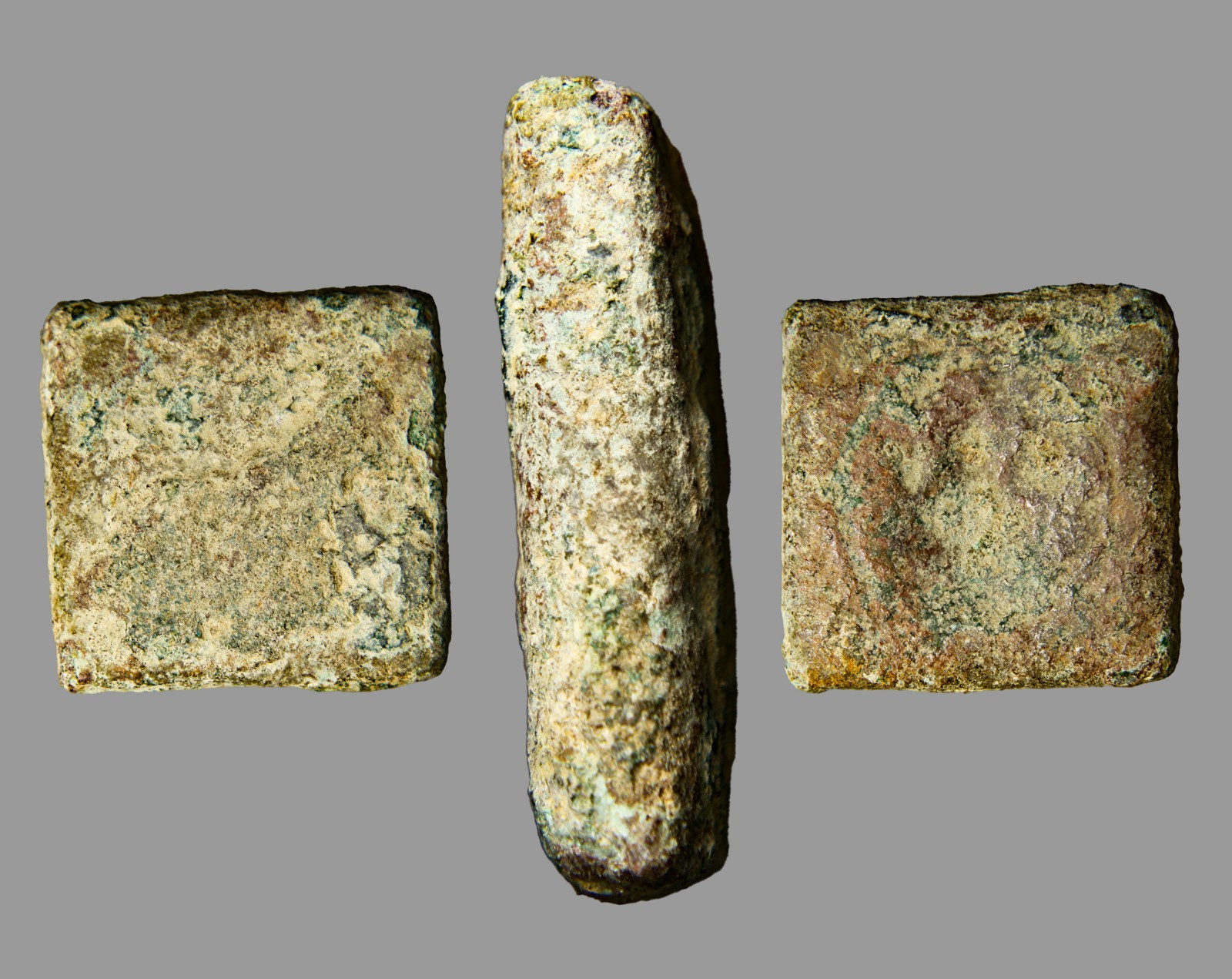
Ancient Judaea Square Lead Commercial Market Weight (22.47g — 2 Shekel Standard / c. 2nd Century BC – 1st Century AD)
Authenticity & Guarantee
Item Specifications & Exact Dimensions
Object: Cast Lead Square Commercial Market Weight (Plumbum Weight)
Culture / Period: Ancient Judaea / Levantine Commercial Sphere (Hasmonean to Herodian Era / Second Temple Period)
Date Range: Circa 2nd Century BC – 1st Century AD (c. 150 BC – 70 AD)
Weight: 22.47 grams (conforms precisely to the 2 Shekel / Double Shekel mass standard, where 1 Shekel ≈ 11.4g; 2 Shekels ≈ 22.8g)
Material: Cast Lead (Plumbum)
Form & Architecture: Heavy square lead plaque featuring a raised perimeter border framing a central cast relief emblem/device; engineered as a official precision market weight for commercial transactions
Condition: Exceptional, complete ancient condition. Full structural density, intact square geometry, preserved under an authentic thick white-cream to tan lead-carbonate (cerussite) oxidation patina with natural light earthen burial encrustations. Free of modern restoration or tooling.
HISTORICAL CONTEXT & TYPOLOGICAL LORE
The 2 Shekel (Double Shekel) Mass Standard in Ancient Judaea
At 22.47 grams, this weight represents an extraordinarily precise 2 Shekel (Double Shekel) unit. In the commercial networks of Second Temple period Judaea, Jerusalem, and Phoenicia (Tyre), the Shekel weight standard (averaging ~11.4 grams per unit) governed silver coinage, temple tribute, and major marketplace transactions. A 2-Shekel lead weight allowed merchants to quickly weigh silver bullion, agricultural produce, and commodities against standard silver coinage such as Tyrian Shekels and Judaean Shekels.
Lead Weights & Municipal Market Regulation (Agoranomoi)
While bronze weights were used for long-term administrative sets, lead (plumbum) was the preferred metal for everyday marketplace trade in ancient Judaea due to its high density, ease of casting, and low cost. Local market inspectors (agoranomoi) tested and verified lead weights in town centers (agora) across Judaea to ensure buyers and sellers adhered to uniform civic weights and measures.
Typological Analysis & Exact Classification
Comparable Archaeological Examples & Museum Accession Numbers
Israel Museum, Jerusalem: Hasmonean and Herodian lead market weights from Jerusalem and Judaean foothills excavations.
Israel Antiquities Authority (IAA Collection, Marisa & City of David): Square lead weights matching the 2-Shekel standard (~22.5g–22.8g).
British Museum (Accession No. 1920,0612.42): Levantine square lead trade weight of the Hellenistic / Roman period.
TRN1-6