When you click on links to various merchants on this site and make a purchase, this can result in this site earning a commission. Affiliate programs and affiliations include, but are not limited to, the eBay Partner Network.
ANTIQUE JAPANESE KYOTO / AWATA CERAMIC CUP/BOWL & SAUCERTAIZAN-RELATED • DISTINCTIVE ROUND IMPRESSED SEAL • RESEARCHED ATTRIBUTION
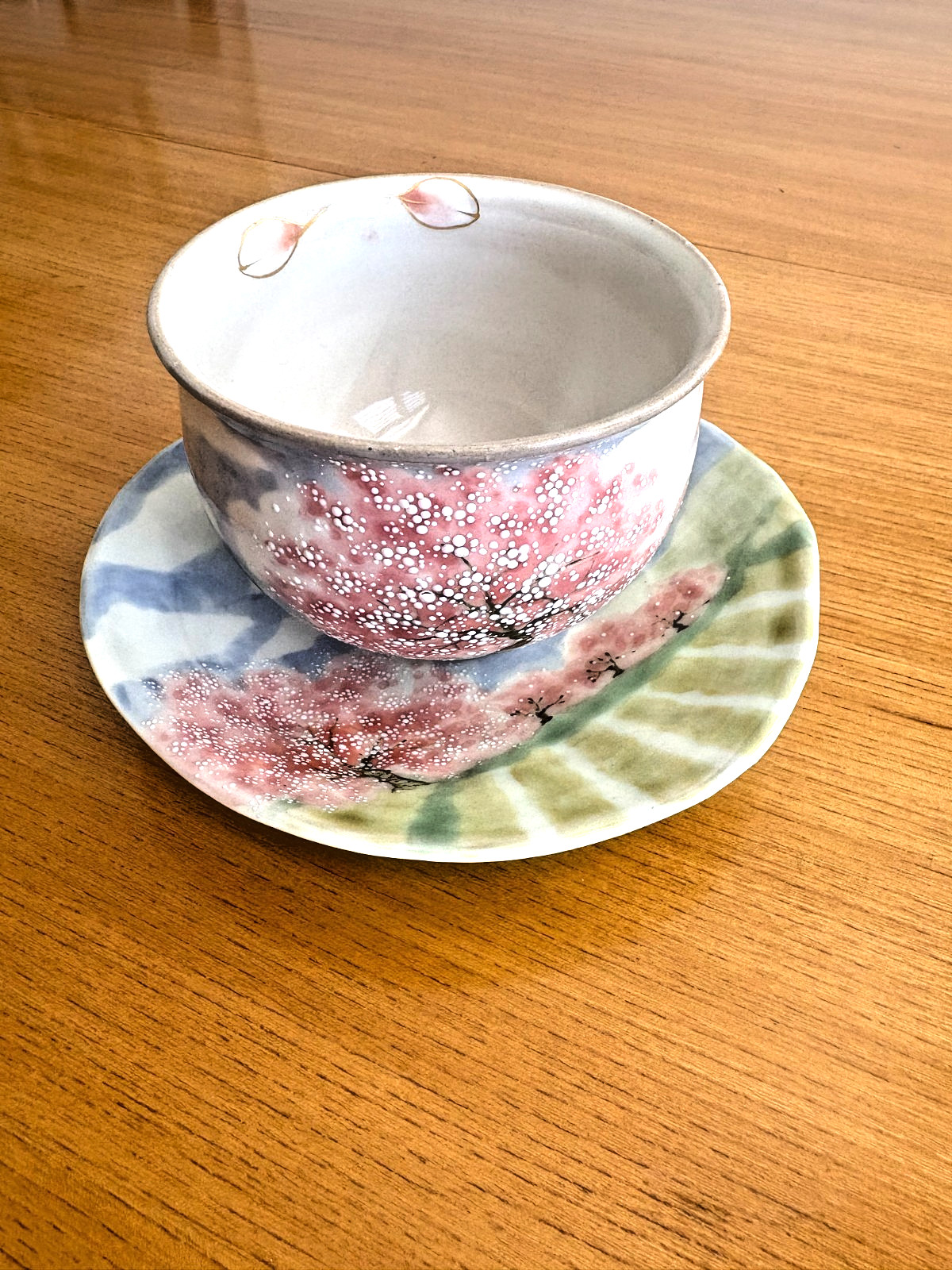
An unusually fine and intriguing antique Japanese ceramic cup/bowl with its matching saucer, distinguished by exceptionally detailed hand decoration, a deliberately organic saucer form, dimensional raised white ornament, a richly varied blue-green ground, and an unusual interior surface treatment.
Both pieces bear the same impressed round maker\'s seal on the underside.
The overall combination of form, ceramic body, decoration, surface treatment and impressed mark has prompted substantial research into the Kyoto/Awata Taizan tradition.
DETAILS
- Cup/Bowl: approximately 3 3/4\" diameter x 3\" high
- Saucer: approximately 5 3/4\" diameter
- Hand-decorated Japanese ceramic
- Deliberately irregular/free-form saucer shape
- Matching impressed maker\'s seal beneath both pieces
- Raised white/moriage-style floral decoration
- Naturalistic flowering-branch motif
- Softly graduated blue, green, yellow and cream ground
- Fine botanical details along the interior rim
- Two small botanical forms along the inner rim appear to be executed in a distinctive metallic gold tone
- Warm rust-brown to reddish ochre/sienna ceramic body, with darker mineral/iron inclusions
- Exceptional condition with no chips or cracks
RESEARCH & ATTRIBUTION
Considerable research has been undertaken on this pair, including comparison of the maker\'s mark, ceramic body, form, surface treatment, decorative techniques, botanical painting and the relationship between the cup and saucer with documented Kyoto/Awata ceramics.
1. The impressed round maker\'s seal
The most significant identifying feature is the round impressed cartouche appearing on both pieces.
Historical references document Taizan and Awata Taizan marks among Kyoto ceramic marks, including impressed examples. The Smithsonian also documents Taizan/Awata ceramics from Awataguchi, Kyoto bearing impressed seals. One Smithsonian Taizan example is specifically described as bearing the Taizan mark impressed on the base; another Taizan/Awata saucer bears an “Awata Taizan” seal.
The precise characters in the present impressed seal are difficult to identify with absolute certainty from the impression alone. Accordingly, the pair is offered as Taizan-related / attributed to the Taizan-Awata tradition, rather than represented as a definitively signed work of a particular Taizan generation.
2. Ceramic body
The exposed ceramic body is particularly distinctive: rust-brown to reddish ochre/sienna, with darker mineral/iron inclusions.
This warmer body coloration is an important physical characteristic of the present pair and should be considered alongside the much more familiar cream-bodied examples of Kyoto/Awata ware.
3. Raised white decoration
The dimensional white floral elements have the tactile character of moriage-style raised decoration, an important component of the highly developed decorative vocabulary of Meiji-period Japanese ceramics.
4. Graduated and softly mottled ground
The blue, green, yellow and cream coloration is not a simple flat ground. The colors transition softly into one another, producing an atmospheric, almost painterly effect.
This type of graduated/sprayed coloration is particularly interesting in the context of later 19th-century Japanese decorative ceramics and the Taizan tradition.
5. The unusual interior surface
The interior is perhaps the most unusual feature of the pair.
A luminous pale/white surface allows the warm rust-brown/ochre color of the underlying ceramic body to emerge in irregular, flowing swirls. The resulting tonal variation appears integral to the original surface rather than staining or subsequent discoloration.
There is an especially interesting Taizan-related precedent for this kind of original swirling surface phenomenon: a documented Taizan vase has fine dark material visible within the glaze around the mouth and base in a subtle swirling pattern. The specialist who catalogued that example could not determine whether the effect was deliberately created or developed during firing, but specifically noted that it was original to the piece.
That comparison is offered as a stylistic and technical precedent, not as a claim that the same technique was necessarily used here.
6. Gold botanical details
Two delicate botanical forms along the inner rim appear in a distinctly metallic gold tone, a restrained detail not otherwise prominently repeated on the cup/bowl or saucer.
Gold decoration is well documented in the work of Taizan Yohei IX. The Smithsonian\'s National Museum of Asian Art has a Taizan Yohei IX vase from Awataguchi, Kyoto, ca. 1890, described as having overglaze enamel and gold decoration incorporating floral sprays and aoi leaves.
This provides another interesting stylistic point of comparison with the present cup.
7. The deliberately irregular saucer
The saucer\'s irregular contour appears intentional rather than the result of damage or poor manufacture.
This is significant because documented Taizan/Awata ceramics include deliberately shaped saucers. The Smithsonian, for example, holds Taizan Yohei saucers made in a five-petaled plum-blossom form.
The present saucer is not being identified as a plum-blossom form; rather, the Smithsonian examples demonstrate that within the Taizan/Awata tradition, the shape of the saucer itself could be an integral part of the artistic design.
8. Hand-Formed Construction: The reverse of the saucer reveals pronounced irregularities in the ceramic surface, including what appear to be hand-formed impressions and subtle pinching/pressing marks. In conjunction with the intentionally irregular perimeter, these features suggest that the saucer\'s organic form was part of its original hand-crafted construction rather than simply an imperfectly formed circle.DATING SIGNIFICANCE
The precise dating of this pair remains an intriguing part of the attribution.
Taizan ceramics are documented across more than one generation and period, so the maker\'s name alone should not be used to assign an exact date.
However, if further specialist examination were to definitively identify the impressed seal and workmanship with a particular Taizan maker or period, the pair could potentially be placed within the important Meiji-era period of Kyoto/Awata ceramic production.
For comparison, the Smithsonian documents a Taizan Yohei IX vase from Awataguchi, Kyoto dated ca. 1890, specifically identified as Meiji era.
This is therefore an object with an unusually interesting research and attribution story, in addition to its decorative appeal.
CONDITION
Exceptional condition.
No chips or cracks noted.
The unusual brown/rust coloration visible within the interior is part of the ceramic\'s original surface appearance and should not be mistaken for staining or later discoloration.
Please examine all photographs carefully, as they form an important part of the description.
A NOTE FOR COLLECTORS
This is not being offered simply as an unidentified decorative Japanese cup/bowl and saucer. The round impressed seal, matching marks, unusual ceramic body, raised decoration, gold detailing, graduated ground, deliberately shaped saucer and distinctive interior surface collectively warrant its identification as a Taizan/Awata-related piece pending definitive mark attribution.
It should be particularly interesting to collectors of Kyoto ware, Awata ceramics, Taizan, Meiji-period Japanese ceramics and Japanese ceramic marks.