When you click on links to various merchants on this site and make a purchase, this can result in this site earning a commission. Affiliate programs and affiliations include, but are not limited to, the eBay Partner Network.
Chemische Fabrik Grünau AG
WWII German Atomic Program
Third Reich Finance
A tale of Nuclear Power and Fish Oil
What You See Is What You Get
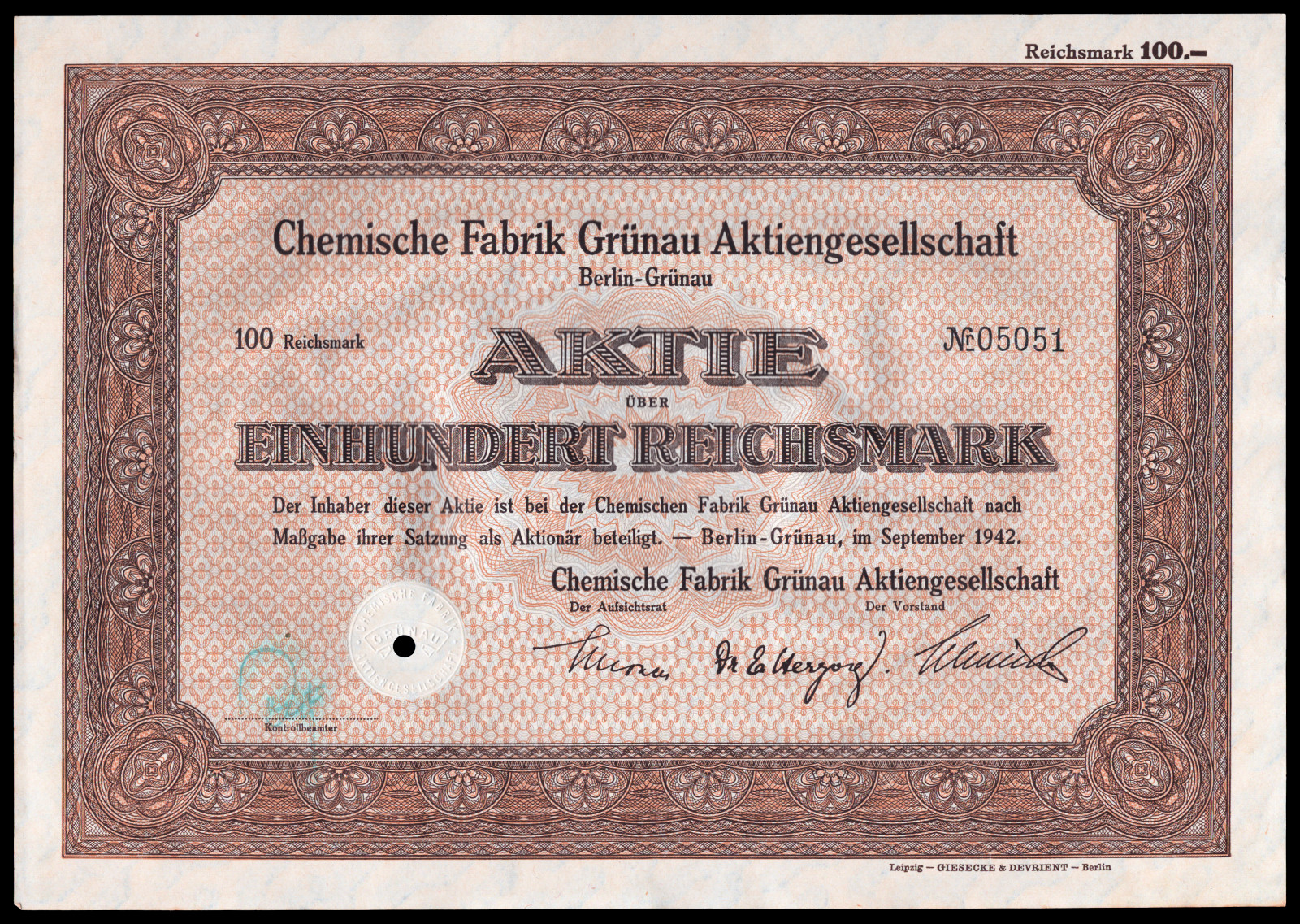
Lot G260805051- Chemische Fabrik Grünau AG played a vital role in the Uranverein (Uranium Club) as a producer of purified uranium used in the nuclear reactor experiments conducted by Werner Heisenberg. You will receive:
Paper solid, crisp, and clean. Lite cockelling. Imperceptible toning and edge wear, exceptional for age. Strong embossing of corporate seal. Printed company officer signatures. Standard European A4 size. Lithograph by Giesecke & Devrient of Leipzig and Berlin; \'GD\' watermarks present. Punch cancel. The front and back of the certificate that you will receive are shown above. See scans.
From the \'Reichsbankschatz\' - Authentic historical artifacts documenting turbulent times. The last 1,000 remaining examples of these VF+ canceled certificates from the vaults of the former Reichsbank in Berlin, were saleed off by the German Federal Office for Central Services and Unresolved Property Issues (Bundesamt für zentrale Dienste und offene Vermögensfragen, BADV,) in 2005, through Germany\'s oldest numismatic sale house, Dr. Busso Peus Nachf. e.K. Proceeds went to aid the victims of Nazi repression.
Appealing to scripophily collectors, historians, and educators alike, it\'s an interesting addition to Second World War, and finance collections. Makes a nice gift for the Old Cold Warrior, student, teacher, or history buff in your life!
ShippedFLAT via USPS Ground Advantage, with tracking.YES! Will combine shipping- Use the Shopping Cart to take advantage of reduced shipping rates for multiple purchases.
Thanks for looking! Please seemyother itemsfor more German, Soviet, WWII and other historical curios.
Q: What am I buying, and why would I want it?
A: Chemische Fabrik Grünau AG, Berlin-Grünau was crucial for the production of uranium used in the German atomic program, and was a company that had a lasting, if over-looked, historical impact.
The company was founded in 1884 by chemists Ludwig Landshoff and Paul Meyer, in the industrialized Berlin suburb of Grünau. It produced intermediate chemicals for use in the paint industry. In 1898 it was incorporated and renamed Chemische Fabrik Grünau Landshoff & Meyer Aktiengesellschaft, and was capitalized at ℳ 2 million. Following World War I it merged with several smaller local companies that provided chemicals to the construction, pharmaceuticals, and textile industries.
In 1921 the large metals refiner and chemical company Deutsche Gold- und Silber- Scheideanstalt (Degussa) took a majority interest in Landshoff & Meyer, with the co-founding Meyer family retaining a 12 percent stake and assuming corporate positions with Degussa. The subsequent Weimar Hyperinflation of 1922/23 and the Great Depression which followed it six years later were disruptive, but the company remained solvent.
With the appointment of Adolf Hitler as Reich Chancellor in 1933 and the ascent of the Third Reich, the Nazi policy of Aryanization —the systematic expropriation of Jewish-owned property and enterprises, and the exclusion of Jews from business and professional life— came into force. Political pressure was brought to bear on Degussa in 1937, and in 1938 the Meyer family, being Jewish, were compelled to sell their shares and resign from the company. Quick to erase the traces of its recent past, the company renamed itself \'Chemische Fabrik Grünau AG, Berlin-Grünau\' (CFG), at its May 1938 board meeting.
The outbreak of WWII saw CFG\'s output diverted to the war effort. In 1941 it was assigned a critical role in the Uranverein (Uranium Club) when it was tasked with the production of uranium tetrafluoride (UF₄), an intermediate step in refining natural uranium. At its peak, CFG was sending several hundred kilos of this \"green salt\" a month to Degussa\'s Frankfurt am Main refineries, where it was reduced into highly purified (non-enriched) uranium, and cast into metal cubes and plates for Werner Heisenberg\'s reactor program.
The 1943 handbook of German public companies showed that for 1942, CFG\'s capital was a nominal ℛℳ 4,000,000.00, in ordinary shares of 3800 shares at ℛℳ 1,000 each (Nos. 1-3800), and 2000 shares at ℛℳ 100 each (Nos. 4001-6000).
On 27 January 1944 an Allied air raid targeted the Grünau plant and heavily damaged much of it. As a result, uranium tetrafluoride production was partially decentralized. However, by late 1944 the Allied Air Campaign had so crippled Degussa\'s primary Frankfurt facilities that uranium refining and casting operations were moved to Grünau. Equipment salvaged from the bombed-out plants was relocated, and a dedicated uranium department (Uranabteilung) was established. Four specialized vacuum melting furnaces (Uranschmelzöfen) were constructed on-site. Along with the salvaged machinery, 3 tons of \'yellowcake\' (ammonium uranate, more recently remembered for its role in the events leading up to the 2003 Iraq War,) was sent to initiate production.
Before it was knocked out of commission in March 1945, Grünau had produced over a ton of refined U-235 cubes for the \"uranium chandelier\" used in the B-VIII nuclear reactor experiments. These tests were conducted in March and April 1945 by Heisenberg’s team in the remote village of Haigerloch. It was Nazi Germany\'s final, desperate attempt to achieve a self-sustaining nuclear chain reaction. Located in a cave under a medieval church in southwestern Germany, French forces had advanced into the area on 22 April 1945, but overlooked the lab. The following day, a team from the \"Alsos Mission\" arrived at the lab. They were part of a highly classified military and scientific intelligence unit run jointly by the United States and Great Britain, whose purpose was to locate and seize Nazi nuclear intelligence, materials, and scientists before they were destroyed or fell into Soviet or French hands. Dismantling began on the 24th and the seized uranium and heavy water was flown to the United States.
After the war the battered Grünau complex lay within the Soviet Occupation Zone, and was expropriated as war reparations. The facility was stripped of its power plant and all uranium processing equipment, which was promptly sent to the Soviet Union for rebuilding. Several of its captured scientists and engineers were held prisoner in the Soviet Union for a decade, and were forced to work on the Soviet atomic bomb program.
In 1949 the communist East German (DDR) government nationalized what little the Soviets had left, and formed the VEB Chemische Werke Grünau. It was later merged into the DDR\'s huge Berlin-Chemie combine. During German Reunification Berlin-Chemie was privatized, and then sold in 1992 to the Italian pharmaceutical giant, Menarini Group. Today, Grünau remains the headquarters of Berlin-Chemie Menarini, one of the largest pharmaceutical companies in Germany. The old dilapidated and contaminated Landshoff & Meyer plant was demolished in the late 1990s, with environmental remediation only being completed in 2011. The 52° Nord complex of approximately 1,000 upscale apartments and condos with mixed commercial stands there now, on the banks of the Dahme River.
Before the Soviets arrived, CFG management had prudently fled Berlin for the West, and to their factory in Illertissen, Bavaria, in the American Occupation Zone. There the rump company was reorganized as Chemische Fabrik Grünau GmbH. In 1961 they rebuilt the factory, and specialized in the production of food additives, pharmaceuticals, and chemicals. In 2010 CFGG was acquired by the BASF corporation and was dissolved into its Food and Health Performance Ingredients Business. Most recently, in September 2025, BASF sold that division to the Louis Dreyfus Company (LDC). The former CFG plant operates today, with 300 employees making food additives and supplements, such as whipping and aeration agents, emulsifiers, and Omega-3 oil.
You will hold history in your hands.
ILLUSTRATION CREDITS:
Vitold Muratov. CC BY-SA 3.0. Cropped by Koba
Uranwürfel_Ketten_Haigerloch
Felix König. CC BY-SA 3.0. Cropped by Koba