When you click on links to various merchants on this site and make a purchase, this can result in this site earning a commission. Affiliate programs and affiliations include, but are not limited to, the eBay Partner Network.
Description
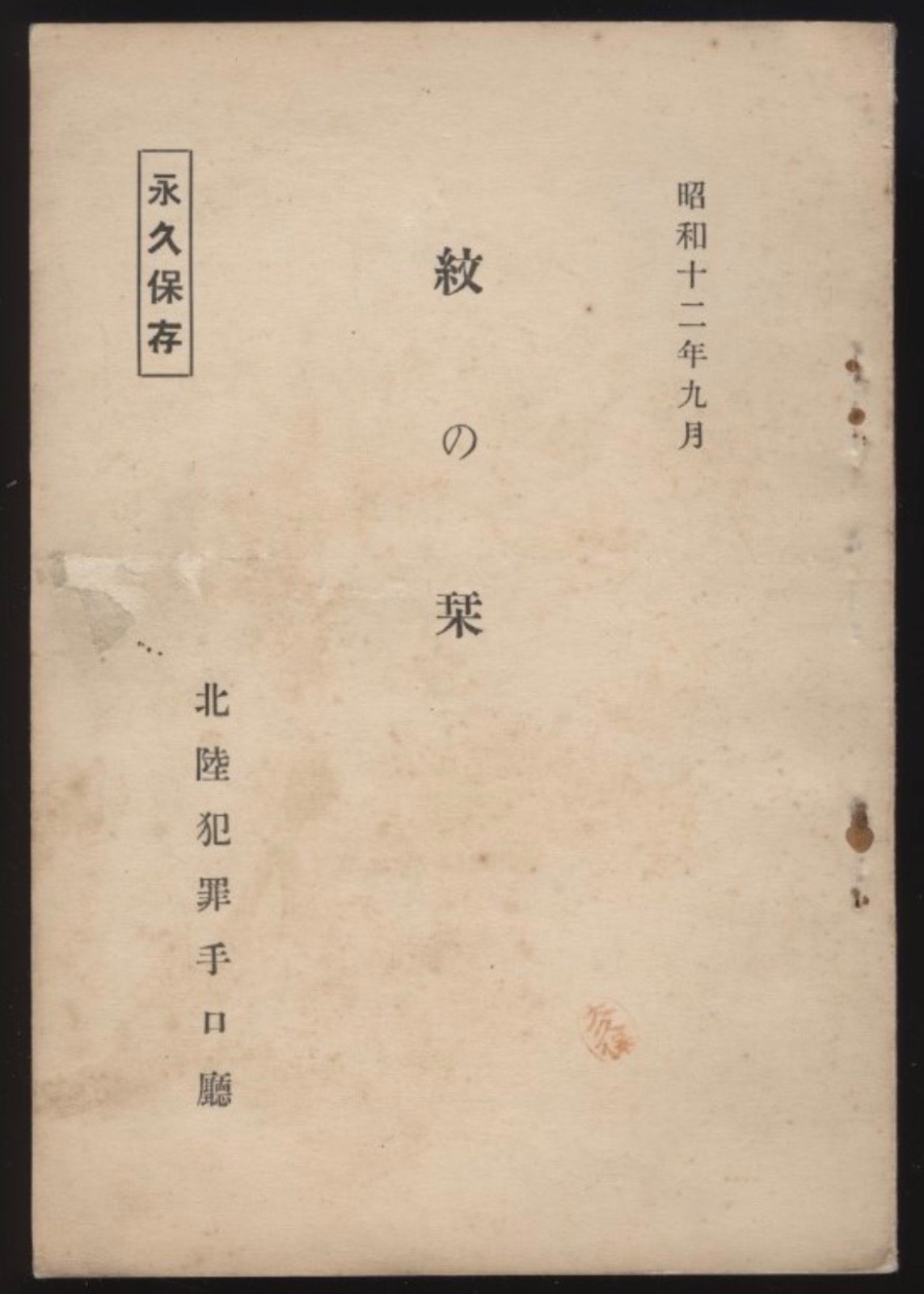
Original prewar Japanese police manual – “Mon no Shiori” (Guide to Family Crests), issued in September 1937 by the Criminal Affairs Bureau of Ishikawa Prefectural Police Department (Hokuriku Crime Techniques Bureau). “Permanent Preservation” edition, not for sale.
📘 Overview
This confidential internal publication was compiled by the local police in Ishikawa Prefecture at the dawn of Japan’s wartime era.
It served as a forensic and identification manual used by investigators, detectives, and pawnbrokers to identify individuals, families, or stolen goods through kamon (family crests).
The book contains both textual explanations of crest classification and hundreds of printed crest illustrations, carefully organized by design and associated surname.
It functioned as an early police database for personal identification — linking traditional Japanese heraldry to criminal and social investigation.
🕰 Historical Context
In 1937, as Japan entered the Sino-Japanese War, the entire nation began to move toward a total-war system.
Police and government authorities expanded surveillance and record-keeping, controlling information about citizens, ideology, and family background.
In that atmosphere, this manual demonstrates how traditional symbols of lineage and honor — the family crest — became part of the modern state’s identification and security apparatus.
While kamon had long represented family pride and ancestry in Japanese culture, during the wartime years they were also used in forensic analysis, census, and mobilization efforts, reflecting how cultural heritage became intertwined with the machinery of control and war.
🧭 Cultural & Research Value
- One of the very few surviving local police-issued manuals on kamon and forensic use.
- A document bridging traditional Japanese culture and wartime surveillance.
- Valuable for researchers in Japanese police history, heraldry, ethnography, and wartime administration.
- Provides a vivid glimpse into how identity, family, and authority were connected in prewar Japan.
📜 Details
- Year: Showa 12 (1937), September
- Issuer: Criminal Affairs Bureau, Ishikawa Prefectural Police (Hokuriku Crime Techniques Bureau)
- Marked “Permanent Preservation” / Non-commercial print
- Approx. 82 pages, 13 × 18.8 cm, vertical Japanese text
- Condition: Aging, toning, light stains and wear consistent with age; overall well-preserved and legible
💬 Collector’s Note
This is not merely a police booklet — it is a mirror of Japan’s social structure on the eve of total war.
It captures the intersection of cultural identity (kamon), state control, and forensic science.
A true artifact for collectors and historians of prewar Japan, wartime society, or early forensic documentation.
Own an authentic piece of Japan’s hidden wartime police history.
Shipping
Worldwide Shipping
International e packet
Delivery Time:
approximate 7-21days(To USA)
With Tracking Number & NO Insurance
International
Import duties, taxes, and charges are not included in the item price or shipping cost. These charges are the buyer\'s responsibility. Please check with your country\'s customs office to determine what these additional costs will be prior to offerding or buying.