When you click on links to various merchants on this site and make a purchase, this can result in this site earning a commission. Affiliate programs and affiliations include, but are not limited to, the eBay Partner Network.
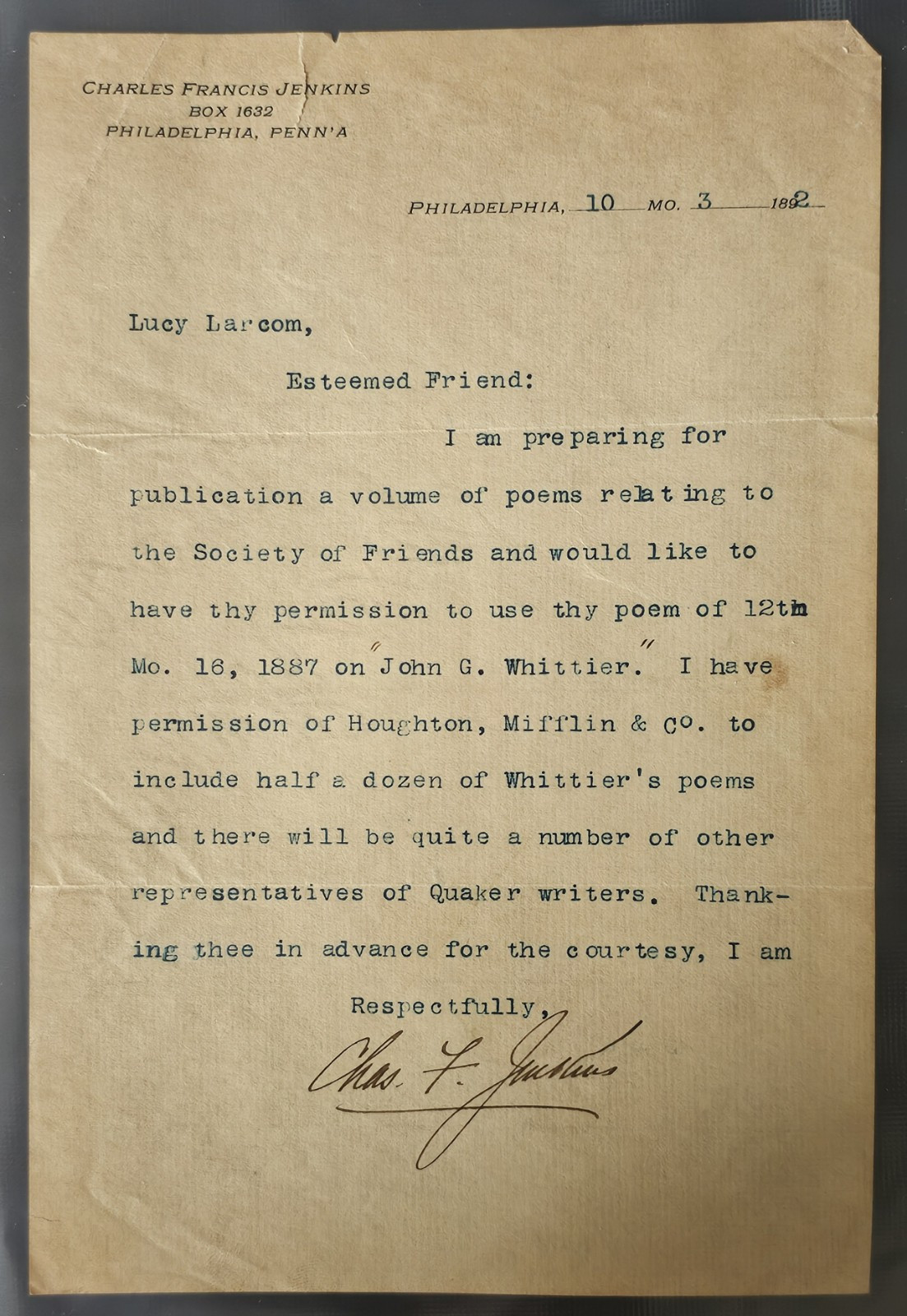
This rare and historically significant letter, dated October 3, 1892, was written by Charles Francis Jenkins, a noted Quaker historian and publisher, to Lucy Larcom, the celebrated poet and abolitionist. The letter seeks Larcom’s permission to include her poem about John Greenleaf Whittier, the famous Quaker poet and abolitionist, in a forthcoming volume of Quaker poetry.
Typed on Jenkins\' personal stationery, this document represents a key moment in 19th-century literary and religious history, showcasing the intersection of Quaker values, abolitionist literature, and historical preservation. It also highlights the active literary efforts within the Society of Friends at the time.
Adding to its historical value, this letter is signed “Chas. F. Jenkins”, making it a desirable piece for collectors of Quaker history, abolitionist literature, and early American poetry.
---
Full Transcription:
(Original spacing and formatting preserved where possible.)
---
CHARLES FRANCIS JENKINS
BOX 1632
PHILADELPHIA, PENN\'A
PHILADELPHIA, 10 MO. 3, 1892
Lucy Larcom,
Esteemed Friend:
I am preparing for publication a volume of poems relating to the Society of Friends and would like to have thy permission to use thy poem of 12th Mo. 16, 1887 on \"John G. Whittier.\" I have permission of Houghton, Mifflin & Co. to include half a dozen of Whittier\'s poems and there will be quite a number of other representatives of Quaker writers. Thanking thee in advance for the courtesy, I am
Respectfully,
(Signed) Chas. F. Jenkins
---
Biographical Information on Key Figures:
Charles Francis Jenkins (1865–1951)
A Quaker historian, publisher, and author based in Philadelphia, Pennsylvania.
Known for his dedication to preserving Quaker history and literature.
Wrote several historical books and contributed to Quaker educational efforts.
Actively involved in historical preservation, including efforts to restore and document important Quaker sites.
This letter reflects his role in curating and promoting Quaker poetry.
Lucy Larcom (1824–1893)
A poet, teacher, abolitionist, and advocate for women’s rights.
Best known for her poetry and memoir, A New England Girlhood, detailing her experiences working in Lowell, Massachusetts textile mills.
Had a close association with John Greenleaf Whittier, who admired and supported her literary work.
Many of her poems reflected Quaker values and social activism.
This letter was written a year before her death, making it an important late-life correspondence.
John Greenleaf Whittier (1807–1892)
One of the most significant American poets of the 19th century.
A devoted Quaker and fierce abolitionist, using poetry as a tool to fight against slavery.
His works, including Snow-Bound, Ichabod, and The Brewing of Soma, remain influential.
Passed away in 1892, the same year this letter was written, indicating that Jenkins was compiling a tribute to Whittier’s legacy.
Houghton, Mifflin & Co.
One of the most prominent American publishing houses of the 19th century.
Published many influential American writers, including Whittier, Emerson, Thoreau, and Hawthorne.
Jenkins mentions that the company granted permission to include Whittier’s poems in his volume, reflecting the high regard for Whittier\'s work at the time.
---
Historical Importance & Collectibility:
1. A Unique Literary Connection:
This letter directly ties together three major 19th-century literary figures: Jenkins (historian/publisher), Larcom (poet/abolitionist), and Whittier (abolitionist poet).
It serves as evidence of the ongoing efforts to preserve and promote Quaker poetry and abolitionist literature.
2. A Moment in Time – Just Before Larcom’s Death:
Written in October 1892, one of Lucy Larcom’s last recorded correspondences, as she passed away in 1893.
This makes it an especially rare piece of Larcom-related ephemera.
3. Quaker Literary Tradition:
The letter reflects the importance of Quaker poetry and its role in social justice movements.
It highlights how literary efforts were used to promote abolitionist ideals and moral teachings.
4. A Signed Historical Artifact:
Charles Francis Jenkins’ signature adds significant value, as he was an important figure in Quaker history and literary preservation.
Ideal for collectors of Quaker documents, abolitionist ephemera, and 19th-century American literature.
---
Condition & Additional Notes:
Condition: Good, with slight creasing and age toning.
Signature: Clearly signed by Chas. F. Jenkins in ink.
Provenance: From a private collection of historical documents.
Authentication: Guaranteed original; not a reproduction or facsimile.
---
Why This Belongs in Your Collection:
This letter is a fascinating piece of American literary and Quaker history, directly connecting key figures of the time. Whether you\'re a collector of Quaker documents, abolitionist history, or early American literature, this item is a must-have. It represents a rare opportunity to own a signed letter from Charles Francis Jenkins, discussing some of the most influential Quaker poets of the 19th century.
Don\'t miss out on this chance to own a truly unique and historically significant document!
---
Buy It Now or Make an Offer Today!
Feel free to reach out with any questions or for additional photos.