When you click on links to various merchants on this site and make a purchase, this can result in this site earning a commission. Affiliate programs and affiliations include, but are not limited to, the eBay Partner Network.
1862 CIVIL WAR SOLDIER LETTER – WILLIAM W. OTTO – 88TH PENNSYLVANIA INFANTRY – FRONT ROYAL, VIRGINIA – STONEWALL JACKSON\'S VALLEY CAMPAIGN – PATRIOTIC UNION STATIONERY
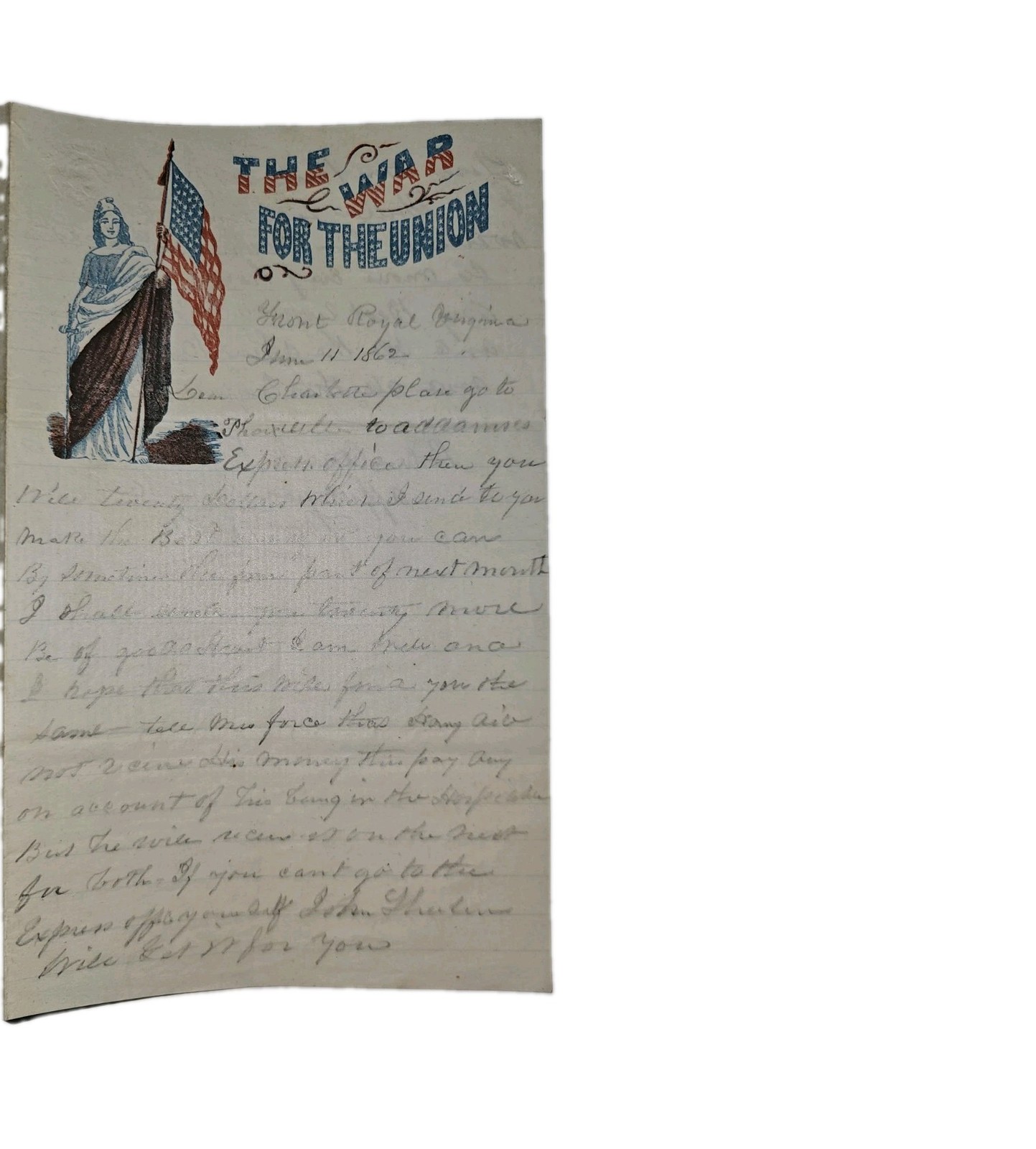
Offered is an original June 11, 1862, Civil War soldier\'s letter written by William Witman Otto (1815–1882), a Union Army private serving in Company F of the 88th Pennsylvania Volunteer Infantry, while stationed at Front Royal, Virginia, during the famous Shenandoah Valley Campaign.
The letter was written to his wife, Charlotte Wise Otto, on beautiful, multicolored patriotic stationery featuring Columbia, the female personification of America, holding the United States flag beneath the prominent inscription:
“THE WAR FOR THE UNION”
Written only 19 days after Confederate General Thomas J. “Stonewall” Jackson\'s victory at the Battle of Front Royal, the letter offers a firsthand glimpse into the experiences of a Union soldier during a critical period of the war.
Otto discusses sending military wages home through Adams Express, promises additional financial support, references a hospitalized soldier whose pay has been delayed, and tells his family that his unit expects to move at any hour.
The correspondence is especially significant because Otto\'s regiment is documented as having participated in the expedition to Front Royal between May 25 and June 18, 1862, precisely matching the letter\'s date and location.
This is an attractive combination of original Civil War manuscript, identified Union soldier, historically important military location, and colorful patriotic letterhead.
BIOGRAPHY – WILLIAM WITMAN OTTO (1815–1882)
Union Army Private, Company F, 88th Pennsylvania Volunteer Infantry
William Witman Otto was a Pennsylvania boatman, husband, father, and Union Army volunteer whose surviving correspondence provides an intimate record of military and family life during the American Civil War.
Born in Pennsylvania in 1815, Otto was the son of Daniel Hitner Otto and Sarah Whitman. He spent much of his adult life in southeastern Pennsylvania, eventually residing in Port Providence, Montgomery County.
Port Providence was a canal community along the Schuylkill River, closely connected to Pennsylvania\'s nineteenth-century transportation and commercial economy.
Otto worked as a boatman on the Schuylkill Canal, an important transportation route connecting Pennsylvania\'s coal-producing and agricultural regions with Philadelphia and surrounding markets.
He married Charlotte Wise, with whom he had five children.
When the Civil War began in 1861, Otto was approximately 46 years old, considerably older than many of the young men volunteering for military service.
Nevertheless, he enlisted in September 1861 and joined Company F of the newly organized 88th Pennsylvania Volunteer Infantry.
Military Service
Otto entered military service during the Union Army\'s rapid expansion following the outbreak of the Civil War.
The 88th Pennsylvania was organized in Philadelphia and assigned to duties in the defenses of Washington and northern Virginia.
During the spring of 1862, the regiment participated in operations around Fredericksburg and the Shenandoah Valley.
In May and June 1862, the 88th Pennsylvania joined the expedition toward Front Royal, Virginia, as Union forces attempted to respond to Confederate General Stonewall Jackson\'s successful Valley Campaign.
The present letter was written on June 11, 1862, during these operations.
Otto\'s comments about military pay, hospitalization, and anticipated troop movements provide a valuable firsthand account of the practical realities facing enlisted Union soldiers.
His statement that the men expected to move at any hour is particularly relevant to the military uncertainty surrounding Jackson\'s movements.
Discharge and Later Life
Otto\'s military career was relatively brief.
On August 12, 1862, he was discharged from the Union Army on a surgeon\'s certificate of disability.
His discharge occurred before the 88th Pennsylvania\'s participation in several of the war\'s most famous battles, including Second Bull Run, Antietam, Fredericksburg, and Gettysburg.
After returning to Pennsylvania, Otto resumed civilian life and eventually returned to work on the Schuylkill Canal.
Another surviving letter attributed to Otto, dated September 29, 1862, discusses his physical condition, canal work, and concern for his former comrades following the regiment\'s heavy losses.
The existence of additional surviving correspondence makes Otto a particularly interesting subject for collectors and researchers of Pennsylvania Civil War history.
William Witman Otto died in 1882.
BIOGRAPHY – CHARLOTTE WISE OTTO
Wife of William Witman Otto – Recipient of the Letter
Charlotte Wise Otto was the wife of William Witman Otto and the mother of their five children.
She lived with her family in Port Providence, Montgomery County, Pennsylvania, a community supported by the Schuylkill Canal and its associated industries.
When William enlisted in the Union Army in September 1861, Charlotte remained at home with their children.
Like many wives of Civil War soldiers, she was responsible for maintaining the household while her husband was absent on military duty.
The present letter illustrates the financial arrangements necessary to support a soldier\'s family.
William instructs Charlotte to collect twenty dollars from an Adams Express office and promises to send another twenty dollars early the following month.
He encourages her to make the best possible use of the money and reassures her that he is well.
The letter\'s affectionate language provides a personal glimpse into their marriage and family life.
It concludes with William sending his respects to Charlotte, the children, and others who have asked about him.
Although Charlotte\'s full birth and death dates have not been independently established here, her identification as William\'s wife is supported by surviving biographical information concerning the Otto family.
BIOGRAPHY – JOHN SHELMIRE / SHELIRE
Family Associate Mentioned in the Letter
John Shelmire, whose surname appears to be written as Shelmire or Shelire, was a trusted acquaintance of the Otto family.
He is mentioned twice in the correspondence.
William instructs Charlotte that John can assist her in retrieving the money from Adams Express if she is unable to visit the office herself.
Later, William asks Charlotte to convey his respects to John and promises to write to him soon.
These references suggest that John maintained a close relationship with the family and was trusted to assist with important financial matters.
He may have been a relative, neighbor, or family friend residing near the Ottos in southeastern Pennsylvania.
His precise identity, occupation, and life dates have not yet been established.
His inclusion is nevertheless historically interesting because it helps document the personal support networks relied upon by soldiers\' families during the Civil War.
BIOGRAPHY – MR. FORCE
Hospitalized Individual Referenced in the Correspondence
A man identified as Mr. Force appears in a passage concerning military pay and hospitalization.
Otto explains that Mr. Force had not received his money on the most recent payday because he was in the hospital.
He indicates that the man should receive his money on the next payday.
This passage is an important example of the administrative complications surrounding Union Army pay and hospitalization.
During the Civil War, soldiers frequently experienced delays in receiving wages because of illness, hospitalization, detached service, or interruptions in military administration.
The reference may concern another member of the 88th Pennsylvania or an individual serving in a nearby Union organization.
His first name and precise military affiliation remain unconfirmed.
BIOGRAPHY – BRIGADIER GENERAL EDWARD OTHO CRESAP ORD (1818–1883)
Union General – Commander Associated with the 88th Pennsylvania\'s 1862 Operations
Edward Otho Cresap Ord was a career United States Army officer who became a prominent Union commander during the American Civil War.
Born in Cumberland, Maryland, on October 18, 1818, Ord graduated from the United States Military Academy at West Point in 1839.
He initially served in the artillery and participated in military operations against Native American forces in the western United States.
When the Civil War began, Ord remained loyal to the Union and received increasingly important commands.
In December 1861, he commanded Union forces at the Battle of Dranesville, Virginia, an early Union victory in the Eastern Theater.
During the spring of 1862, Ord commanded a division in the Department of the Rappahannock.
The 88th Pennsylvania served in his division during the period surrounding the Front Royal expedition.
Ord subsequently served in the Western Theater, including operations associated with the Vicksburg Campaign.
He later commanded the Army of the James and played an important role in the final Union campaigns against Richmond and Petersburg.
After the war, Ord continued his Regular Army career, serving in several important military departments.
He died on July 22, 1883, in Havana, Cuba.
Although Ord is not personally named in the letter, his command provides important organizational context for Otto\'s military service.
BIOGRAPHY – GENERAL THOMAS J. “STONEWALL” JACKSON (1824–1863)
Confederate General – Commander of the 1862 Shenandoah Valley Campaign
Thomas Jonathan Jackson was one of the Confederacy\'s most prominent military commanders and a central figure in the events surrounding this letter.
Born January 21, 1824, in Clarksburg, Virginia, now West Virginia, Jackson graduated from West Point in 1846.
He served with distinction during the Mexican-American War and later became an instructor at the Virginia Military Institute in Lexington.
Following Virginia\'s secession in 1861, Jackson joined the Confederate Army.
He gained national recognition during the First Battle of Bull Run in July 1861, where his steadfast defense earned him the nickname “Stonewall.”
The 1862 Shenandoah Valley Campaign
During the spring of 1862, Jackson conducted a remarkable series of military operations in Virginia\'s Shenandoah Valley.
His forces moved rapidly between widely separated Union commands, repeatedly attacking isolated Federal formations.
On May 23, 1862, Jackson defeated Union troops under Colonel John R. Kenly at the Battle of Front Royal.
The Confederate victory helped force Union General Nathaniel P. Banks to retreat from Strasburg toward Winchester.
Jackson subsequently won the First Battle of Winchester on May 25.
Union forces pursued Jackson southward, resulting in further fighting at Cross Keys on June 8 and Port Republic on June 9.
These victories effectively concluded Jackson\'s Valley Campaign and allowed him to reinforce General Robert E. Lee near Richmond.
William Otto\'s letter was written from Front Royal on June 11, 1862, just two days after Jackson\'s victory at Port Republic.
Jackson later participated in the Seven Days Battles, Second Bull Run, Antietam, Fredericksburg, and Chancellorsville.
He was accidentally wounded by Confederate troops following the Battle of Chancellorsville and died on May 10, 1863.
Jackson is not named in Otto\'s correspondence, but his military operations form the immediate historical background of the letter.
BIOGRAPHY – COLONEL JOHN REESE KENLY (1818–1891)
Union Commander at the Battle of Front Royal
John Reese Kenly was a Maryland lawyer, Mexican-American War veteran, and Union Army officer.
Born in Baltimore on January 11, 1818, Kenly studied law and was admitted to the Maryland bar.
He served in the Mexican-American War before returning to civilian life.
When the Civil War began, Kenly joined the Union Army and became colonel of the 1st Maryland Infantry.
On May 23, 1862, he commanded approximately 1,000 Union troops defending Front Royal, Virginia.
His force was attacked by Stonewall Jackson\'s much larger Confederate command.
Despite determined resistance, Kenly\'s troops were overwhelmed, and he was wounded and captured.
The Confederate victory at Front Royal became an important turning point in Jackson\'s Valley Campaign.
Kenly was later exchanged and returned to Union service, eventually attaining the rank of brigadier general.
After the war, he resumed civilian life in Maryland.
He died in Baltimore in 1891.
Kenly\'s connection to this letter is geographical and historical: his defeat occurred at Front Royal just 19 days before Otto wrote from the same location.
HISTORY – THE 88TH PENNSYLVANIA VOLUNTEER INFANTRY
The 88th Pennsylvania Infantry was organized in Philadelphia during September 1861.
The regiment was initially commanded by Colonel George P. McLean and drew recruits from Philadelphia, Reading, and surrounding Pennsylvania communities.
After organization, it traveled to Washington, D.C., and served in northern Virginia.
Its early duties included protecting important military infrastructure, guarding railroad lines, and participating in operations against Confederate forces.
During May and June 1862, the regiment joined Union movements intended to intercept Stonewall Jackson.
The regiment\'s documented service includes:
Expedition to Front Royal, Virginia – May 25 to June 18, 1862
This period directly encompasses the June 11 date of Otto\'s letter.
Following Otto\'s discharge in August 1862, the 88th Pennsylvania continued serving with distinction.
Its later engagements included:
Second Battle of Bull Run – August 1862
Battle of South Mountain – September 1862
Battle of Antietam – September 1862
Battle of Fredericksburg – December 1862
Battle of Chancellorsville – May 1863
Battle of Gettysburg – July 1863
Battle of the Wilderness – May 1864
Battle of Spotsylvania Court House – May 1864
Battle of Cold Harbor – June 1864
Siege of Petersburg – 1864–1865
Appomattox Campaign – April 1865
The regiment suffered significant casualties during its wartime service.
It was mustered out on June 30, 1865.
The regiment\'s experiences were later documented by John D. Vautier in his 1894 history, History of the 88th Pennsylvania Volunteers in the War for the Union, 1861–1865.
Important distinction: William Otto was discharged in August 1862 and did not personally participate in the regiment\'s later battles.
ORIGINAL LETTER – CONTENTS AND TRANSCRIPTION
Printed patriotic heading:
THE WAR FOR THE UNION
Manuscript heading:
Front Royal Virginia
June 11 1862
Letter:
Dear Charlotte please go to
Phoenixville to adams
Express office then you
will [find] twenty dollars which I send to you
make the Best use of it you can
By sometime the fore part of next month
I shall send you twenty more
Be of good Heart I am well and
I hope that this will find you the
same tell Mr force [that he did]
not receive this money this pay day
on account of his being in the Hospital
But he will receive it on the next
pay day
If you cant go to the
Express office your self John Shelmire
Will get it for you
Give my Best respects to
John Shelire tell him I shall
write to him soon
we Expect to move every hour
My Best respects to you
and all the Children
and all that Inquire after us
Believe Me to Be yours
affectionate father
Wm. W. Otto
Transcription is approximate. Certain words and names remain difficult to decipher and should be compared with the original manuscript.
HISTORICAL SIGNIFICANCE OF THE LETTER1. Written During Stonewall Jackson\'s Valley Campaign
The letter dates to June 11, 1862, during the immediate aftermath of Jackson\'s victories at Cross Keys and Port Republic.
Its Front Royal location places it within the area of active Union military operations.
2. Identifiable Pennsylvania Union Soldier
The writer can be associated with William Witman Otto of Company F, 88th Pennsylvania Infantry, whose documented service corresponds with the date and location.
The survival of other Otto correspondence provides valuable biographical context.
3. Firsthand Reference to Troop Movements
Otto\'s statement:
“we Expect to move every hour”
is one of the letter\'s most interesting passages.
It reflects the uncertainty and readiness for movement experienced by Union soldiers during the campaign.
4. Military Pay and Family Support
Otto sends twenty dollars home and promises another twenty dollars the following month.
This provides direct evidence of how enlisted soldiers supported their families financially while serving in the field.
5. Adams Express Company
The letter references Adams Express, one of the most important express transportation and financial services companies in nineteenth-century America.
Its use by Union soldiers illustrates the logistical networks that connected military camps with civilian communities.
6. Hospitalization and Delayed Pay
The reference to Mr. Force\'s hospitalization and delayed military wages provides an additional glimpse into the practical difficulties of army life.
7. Attractive Patriotic Stationery
The colorful illustration of Columbia holding the American flag and the slogan “THE WAR FOR THE UNION” make the document visually distinctive.
Patriotic stationery was an important expression of wartime national identity, and surviving examples with original soldier correspondence are desirable historical artifacts.
8. Family and Social History
The letter documents the relationship between a Pennsylvania soldier, his wife, their children, and trusted family acquaintances.
It preserves the everyday experiences of a family separated by the Civil War.
CONDITION
Original Civil War-era handwritten letter on illustrated patriotic stationery, dated June 11, 1862.
Displays expected age-related toning, original fold lines, scattered spotting, staining, and some fading of the handwritten text.
The patriotic illustration retains attractive red and blue coloration.
Please examine all photographs carefully for the document\'s condition, manuscript details, and any imperfections.
COLLECTOR INTEREST
Particularly appealing to collectors of:
Original American Civil War soldier letters
Union Army manuscripts and correspondence
88th Pennsylvania Volunteer Infantry
Pennsylvania Civil War history
Shenandoah Valley Campaign
Stonewall Jackson and Front Royal
Civil War patriotic stationery
Illustrated Union letterheads
Civil War military pay and postal history
Adams Express American family correspondence
A historically significant original June 11, 1862, Union soldier\'s letter from Front Royal, Virginia, attributed to Private William Witman Otto of the 88th Pennsylvania Infantry. Written during the Shenandoah Valley Campaign on colorful “THE WAR FOR THE UNION” patriotic stationery, the letter preserves firsthand references to military pay, hospitalization, family support, and anticipated troop movements.
Original antique document pictured is the exact item offered for sale.