When you click on links to various merchants on this site and make a purchase, this can result in this site earning a commission. Affiliate programs and affiliations include, but are not limited to, the eBay Partner Network.
[COLLECTION OF AUTOGRAPHED DOCUMENTS - ADOLPHE THIERS - 1830/1840 - JULY MONARCHY]
-
We sell here
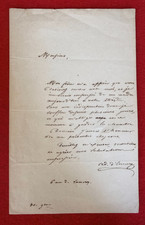
An extremely rare and very desirable document signed Emile Babeuf, booksellerSupplier here of Volume 5 of the Works of Napoleon (which he himself published)to the illustrious Adolphe Thiers, a little before it launches into publication of his great work of the 20 volumes of the History of Consulate and Empire (started in 1843)
Broad and powerful writingAutograph of great beauty
Extremely rare piece
1 free sheet, size approximately 19 x 14.5cm
Very good general condition, barely yellowed,clean, minor usual creases or rubbing
cf. visuals...
- Emile Babeuf1785-1842
Bookseller, publisherFather: Gracchus BabeufMother: Marie-Anne Victoire Langlet Robert Babeuf, known as Émile Babeuf, born September 29, 1785 in Roye, died January 23, 1842 in Paris, is a French bookseller-publisher, eldest son of revolutionary Gracchus Babeuf of which he worked to make ideas known.
Biography
Family and childhoodÉmile Babeuf is the eldest son of François Noël known as Gracchus Babeuf and Marie-Anne Victoire Langlet (baptized in Amiens on February 13, 1757, died after 1840), daughter of Antoine Langlet, ironmonger from Amiens, and former chambermaid in the Bracquemont family, who were married in Damery (Somme) on November 13, 1782. At his birth, he received the first name Robert, which his father changed later to call him Émile, in homage to Rousseau.
In 1794, he participated, with his mother, in the folding and shipping of the Journal de la liberté de la presse published by his father and printed by Guffroy.
During his father\'s trial in Vendôme, when he was barely twelve years old, the public prosecutor, Vieillart, uses Émile\'s correspondence as an aggravating circumstance, which excites the indignation of the “Tribun du peuple”. It was also said that he was the one who carried to his father the dagger with which he killed himself, when the verdict was announced.
Threatened by poverty after the death of his father, he was adopted in 1798 by Félix Lepeletier, who places him in a pension. As for her mother, she became a toilet seller, rue Saint-Honoré, business which she still carried out in 1840.
Bookstore employeeÉmile remained in boarding school until Lepeletier was deported to the Île de Ré in 1801. He was employed by a bookseller in Paris for six years then, in 1808, became a traveling salesman for the Turneisen bookstore, based in Basel, traveling to Spain, Italy and Switzerland. In Seville, according to some improbable accounts, he met Lieutenant-Colonel Grisel, the man who denounced his father, in a café, challenged him to a duel and killed him with a sword. Included in the roundup following General Malet\'s conspiracy of 1808, he left Paris, where he lived with his mother, rue Saint-Honoré, and settled in Lyon, where on December 27, 1809 he married Catherine Finet, a bookseller born on March 25, 1769 with whom he had two children, and became a licensed bookseller on January 1, 1813.
Political commitmentIn 1814, he took an active part in the defense of the city. Forced to abandon his bookstore, occupied by enemy horsemen, he followed the army corps of Marshal Augereau.
During the Hundred Days, he placed himself in the service of Napoleon; Lazare Carnot, Minister of the Interior, entrusts him with a mission in Champagne. Established as a bookseller in Paris, he published patriotic and liberal brochures, notably texts by Marc-Antoine Jullien, in association with Laurent Beaupré.
On the return of the Bourbons, he published the Nain tricolore, a satirical opposition newspaper inspired by of Nain jaune, the only issue of which appeared in January 1816. Arrested on February 26, 1816 as publisher, he refused to name the editors (among whom were Pierre Joseph Spiridon Duféy de l\'Yonne, Stanislas Bouquot and Georges Zénovietz), which led to his being sentenced on June 11, 1816, in accordance with the law of November 9, 1815, to the maximum penalty, that is to say deportation. First interned at the Conciergerie, he was taken to Mont Saint-Michel on November 17, 1817. During the trip, several deportees managed to escape and went abroad. Left alone a league from Vire with his escort, he continued his journey to Mont Saint-Michel, where he spent a year.
Bookseller-publisher in ParisAmnestied on September 9, 1818 for \"good behavior\", he was authorized to return to Paris, where he resumed his activities as a bookseller-publisher, in the Saint-André-des-Arts district, printers’ district, under the name of the “Librairie historique d’Émile Babeuf”, which became in 1828 “Historical and arts and crafts bookstore” and located at no. 123 rue Saint-Honoré.
In particular, he publishes works relating to to the history of the French Revolution, like the Summary of the history of the French Revolution by Jean-Paul Rabaut Saint-Étienne or the Table of the French Revolution from its origin until 1814 by Jacques Marquet de Montbreton de Norvins, reappeared in 1820, but also the Historical Dictionary of Youth by Antoine Antoine de Saint-Gervais and \"a new edition, revised, corrected and continued until 1789\" of the six volumes of the Historical, Philosophical and Critical Dictionary, abridged by Bayle and the great biographical dictionaries which appeared until the publication of the new biography of Ladvocat\'s contemporaries in 1822, or volume 11 of the New Biography of the Contemporaries of Antoine-Vincent Arnault, Antoine Jay, Étienne de Jouy and Norvins, jointly with the Historical bookstore of the Hôtel d\'Aligre in 1823.
In 1821, he launched a collection of “important pieces relating to the French Revolution” which merged the following year with the collection of “Memoirs relating to the French Revolution” by the Baudoin brothers, which brings together thirty titles in 1830. Published authors include Necker, Dumouriez, Louvet and Napoleon, whose works are the subject of a compilation in five volumes.
Following the publication, by the Romantic Bookstore in Brussels, of History on the conspiracy of Equals by Philippe Buonarroti, in 1829 he planned to publish in four volumes the works of his father under the title of Memoirs of FN Gracchus Babeuf, Tribune of the People. The prospectus for the project was distributed in June 1830, the first two volumes to be made up of History. But the project failed due to opposition from Buonarroti, who criticized it for its “Napoleonicism”. Only are reissued in Paris, under the name of Baudoin Frères, the two volumes of Buonarroti\'s book.
In 1830, after the Trois Glorieuses, Émile Babeuf\'s historic bookstore was established at no. 11 rue de la Harpe. He still published various works until around 1834-1835.
Subsequently, we know that he made a request for an allowance: in the report written by the prefect of the Seine for the mayor of the 11th arrondissement, where he lived at the time, it is indicated that \"he previously worked in a bookstore, but today he lives from day to day.\"
-
Adolphe Thiers, born April 15, 1797 (26 germinal year V) in Marseille (Bouches-du-Rhône) and died September 3, 1877 in Saint-Germain-en-Laye (Seine-et-Oise), is a French lawyer, journalist, historian and statesman.
Arriving in Paris at 24, ambitious and without fortune - he would have served as Balzac\'s model for the character of Rastignac -, anticlerical journalist and patriot of the liberal opposition, successful author of a History of the French Revolution, he is an example of the evolution of the French ruling classes in search of a new stable institutional order after the collapse of the absolute monarchy in 1789, through his major role in the establishment of political regimes successive ones following the failure of the Restoration in 1830.
He contributed to the Three Glorious Years and played a decisive role in the establishment of the July Monarchy. Elected to the French Academy, married and became rich, he was a deputy, several times a minister and twice president of the Council. Supporter of a constitutional monarchy in which \"the king reigns, but does not govern\", he distances himself from King Louis-Philippe I in the name of the “national” spirit on foreign policy (crisis of 1840) and became Guizot\'s adversary in the name of parliamentary freedoms.
After the revolution of 1848, he joined the Republic and became one of the figures of the Order party. Opposed to the coup d\'état of December 2, 1851 by the future Napoleon III, whose candidacy for the presidency of the Republic he had supported in 1848, he did not join the Second Empire and began a long journey through the desert. He wrote the continuation of his Revolution, the History of the Consulate and the Empire in twenty volumes, which were once again a bookstore success. Elected in 1863 in Paris, he became one of the main speakers of the liberal opposition and opposed the Franco-Prussian War of 1870.
In February 1871, after the fall of the Second Empire following the defeat of Sedan during the war against Prussia and the failure of the Provisional Government of National Defense, he became \"head of the executive power of the French Republic\", that is to say both head of state and government, Jules Dufaure being vice-president of the Council. He negotiated the peace treaty with Bismarck and bloodily repressed the insurrection of the Paris Commune.
He is considered by all revolutionary leftists as an architect of the massacre of the Communards. during bloody week.
In August 1871, by the Rivet law, he became President of the French Republic. It notably organizes the national loan which allows the early evacuation of the territory by the occupying troops. In March 1873, he was hailed by the National Assembly as “the liberator of the territory”.
His rallying to a “conservative Republic” led to his being outvoted by the monarchists in May 1873, majority in the National Assembly, and led to his resignation from the presidency of the Republic. But he opened the way to a rapprochement between the liberal Orleanist right and the moderate republicans led by Léon Gambetta, an alliance which, through of “opportunism”, will found the Third Republic.
In January 1840, the date of his purchase, Thiers was a deputy, and would become For the second time in March President of the Council (Thiers II Government - under the reign of Louis-Philippe) after having held numerous ministerial positions (Interior, foreign affairs, trade) and having entered the French Academy in 1833.
He has already enjoyed great literary success with his work \"History of the French Revolution\" (1923-1927, 10 volumes) and prepares to write his monumental \"History of the Consulate and the Empire\" (20 volumes), continuation of the previous one, the writing of which occupied it between 1843 and 1869
He was employed by a bookseller in Paris for six years then, in 1808, became a traveling salesman for the Turneisen bookstore, based in Basel, traveling to Spain, Italy and Switzerland. In Seville, according to some improbable accounts, he met Lieutenant-Colonel Grisel, the man who denounced his father, in a café, challenged him to a duel and killed him with a sword. Included in the roundup following General Malet\'s conspiracy of 1808, he left Paris, where he lived with his mother, rue Saint-Honoré, and settled in Lyon, where on December 27, 1809 he married Catherine Finet, a bookseller born on March 25, 1769 with whom he had two children, and became a licensed bookseller on January 1, 1813. After the revolution of 1848, he joined the Republic and became one of the figures of the Order par Recommended products Provided by [COLLEC. ADOLPHE THIERS] RARE AUTOGRAPHE SIGNE Ca 1839 CHARLES MIRBEL Botaniste View product [COLLEC. AD. THIERS] Rare Autograph Signed Ca 1840 Prof. Achille Valenciennes View product [COLLECTION ADOLPHE THIERS] FAC SIMILE AUTOGRAPH COLIGNI / Ed. 1830 (Litho) View product [ADOLPHE THIERS COLLECTION] FAC SIMILE AUTOGRAPH BIRAGUE / Ed. 1830 (Litho) View product [COLLECTION ADOLPHE THIERS] FAC SIMILE AUTOGRAPH BUFFON / Ed. 1830 (Litho) View product [COLLECTION ADOLPHE THIERS] FAC SIMILE AUTOGRAPH DUMOURIEZ / Ed. 1830 (Litho) View product [COLLECTION ADOLPHE THIERS] FAC SIMILE AUTOGRAPH LOUIS XI / Ed. 1830 (Litho) View product [COLLECTION ADOLPHE THIERS] FAC SIMILE AUTOGRAPH A. ARNAULD / Ed. 1830 (Litho) View product









![[COLLECTION ADOLPHE THIERS] Superb Signed Autograph Document Emile Babeuf 1840](img-large/g/3jkAAeSw~OJovybs/s-l1600/-COLLECTION-ADOLPHE-THIERS-Superb-Signed-Autograph.jpg "[COLLECTION ADOLPHE THIERS] Superb Signed Autograph Document Emile Babeuf 1840")